

Sage Appliances (Breville) invited me to meet them at the Paris Coffee Show in September 2026. During this meeting, through the presentation of four espresso machines, I was walked through the brand's evolution and its philosophy on coffee.
An idea: the same extraction quality, whatever the price
The brand's principle fits in one sentence: whichever machine you choose, the extraction quality is the same. It rests on four key elements, dose, pressure, temperature and steam temperature, and what changes from one model to the next is the level of assistance, or even automation.
These machines aim to help everyone become their own barista, with no training required, while teaching the fundamentals such as grind size. The brand reminds you that a good espresso is a whole: machine, coffee, cup and water. The range even starts with a question of taste rather than a technical one: black or with milk?
The Impress series from Sage: black espresso or milk-based drinks?
Barista Express Impress
If you prefer a non-milk drink, the Barista Express Impress™ is, according to the brand, the perfect machine. This first machine in the range provides a first level of assistance: it lets you tamp straight down with consistent pressure, an important factor to avoid channeling. The tamper applies 10 kilos of pressure and twists by 7 degrees, for a level puck of 18 g, while the machine learns the right dose for your grind size.
As shown in the video, the pressure gauge indicates the extraction pressure at the group head, which helps ensure a good extraction, in the so-called "espresso range," around 9 bar.
When it comes to steaming milk, the barista will need to learn the technique with the included pitcher, since this machine has no automatic milk frother.
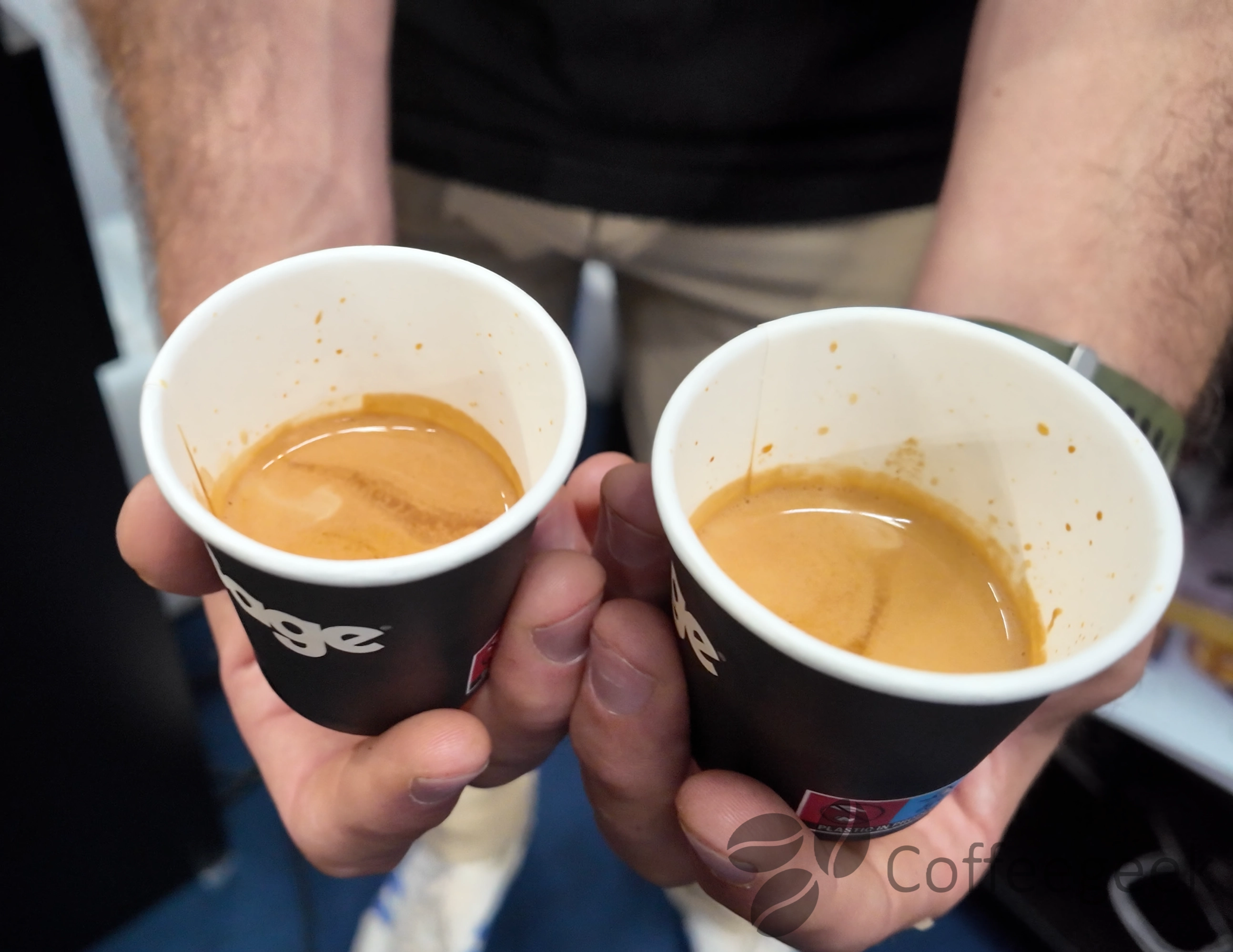
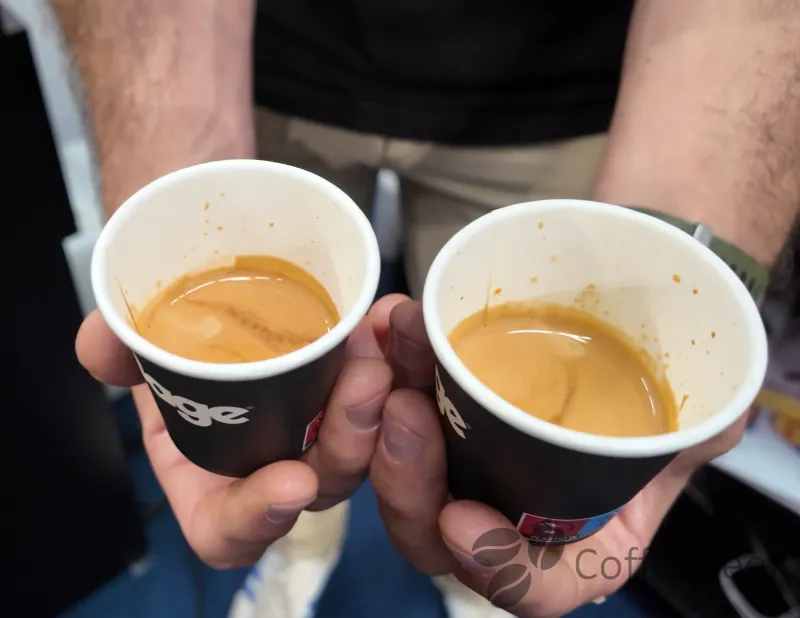
Despite the difficult conditions of extracting espresso at a trade show, the Barista Express Impress managed to pull an excellent espresso, with a lovely hazelnut crema. During the demonstration, I also found the grinder fairly quiet, which is genuinely appreciable for home use.
Barista Touch Impress
For milk-based drinks, the Barista Touch Impress steams the milk automatically. You tell it what type of milk you're using (cow, almond, oat or soy) and the machine adjusts the steaming temperature, since they don't all react at the same temperature: for example, 60 °C for oat milk, versus 65 °C for cow's milk. A small temperature sensor, placed against the pitcher, reads its temperature and infers the milk's temperature from it. The principle is simple: all you need to do is read the machine's prompts to prepare your drink, even with no experience.
On the coffee side, you'll find the same tamping system: you pick a grind size, the machine doses, then you tamp, again with 10 kilos of pressure. During extraction, a timer lets the machine know if the coffee is flowing too fast: it then advises making the grind finer so the next coffee is even better. Conversely, if the coffee flowed too slowly, the machine tells you to make the grind coarser.
Its ThermoJet heating system is ready in 3 seconds, and it takes 3 more to switch from extraction to milk steaming. The ThermoJet also lets you lower the temperature for cold brew and cold espresso.
Oracle Jet and Oracle Dual Boiler: automatic, manual, or both
Next, I was introduced to the Oracle range, which moves up to a 58 mm portafilter. The Oracle Jet grinds, doses, distributes and tamps entirely on its own: a propeller distributes the grounds the way a distribution tool would, before tamping. A volumetric control paired with the extraction time lets it know whether the grind is too fine or too coarse, and it then tells you precisely how much to adjust the grinder by. Its temperature sensor, housed directly in the steam wand, offers a precision of around 1 °C.
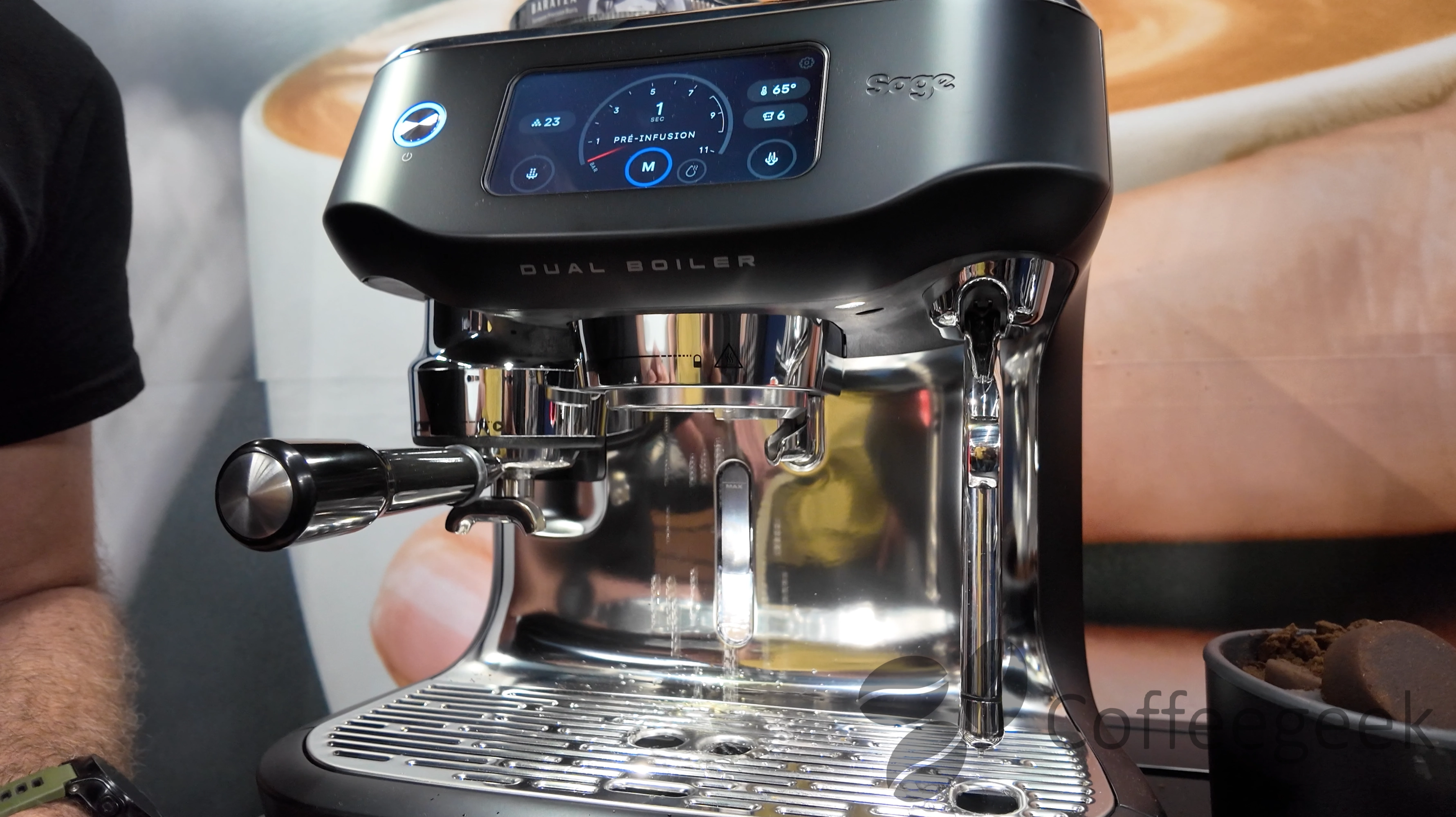
The Oracle Dual Boiler picks up this same grinding system and adds two boilers of one litre each, one for extraction, the other for steam, both available at the same time. Grind adjustment becomes motorized: an electric motor moves the burrs apart or together automatically depending on the drink chosen, never leaving them under pressure while the machine is switched off.
Every type of extraction, a tight espresso, a café crème, a milk-based drink, calls for its own grind setting. Being able to adjust the grind on the fly and automatically, with no manual intervention on the grinder, is genuinely appreciable.
It offers an automatic mode driven by volume, for example 36 g in the cup.
On top of this assisted mode, the Oracle Dual Boiler offers a 100% manual mode that provides full personalization of the extraction: the duration of the pre-infusion, the bloom and the infusion can each be set independently, up to the stop. All of these settings can be adjusted and then saved, to reproduce exactly the same recipe from one extraction to the next. This manual mode naturally extends to the grinder too, which can be adjusted by hand, or even swapped for an external grinder. Enough to let beginners and experienced baristas share the same machine.
My take on this meeting
I truly enjoyed this conversation: my host clearly mastered the subject, and throughout our talk I sensed a coherent brand philosophy, that of offering good equipment built for a single purpose, making good coffee without being a barista. To my mind, this type of machine is a genuine gateway into quality coffee: they can pull excellent espressos, steam milk automatically, and little by little, some users will want to go further, an external grinder, then a more manual machine, exactly as the brand itself illustrated during our conversation.
I also really liked the possibility, on the higher-end machines, of letting the household barista and the occasional user share a single piece of equipment under one roof, the household barista who wants to personalize every step of their extraction, and the occasional user who just wants a good coffee.
These machines offer assistance or automation, depending on the model, which opens up real paths towards good coffee. To my mind, this is a market of its own, and it would be a mistake to compare them to bean-to-cup automatic machines like De'Longhi or Jura, which don't allow for that same progression towards greater mastery.
Thank you
Thank you to Sage Appliances for inviting me to this event: it's always a pleasure to talk with people who are passionate about coffee.