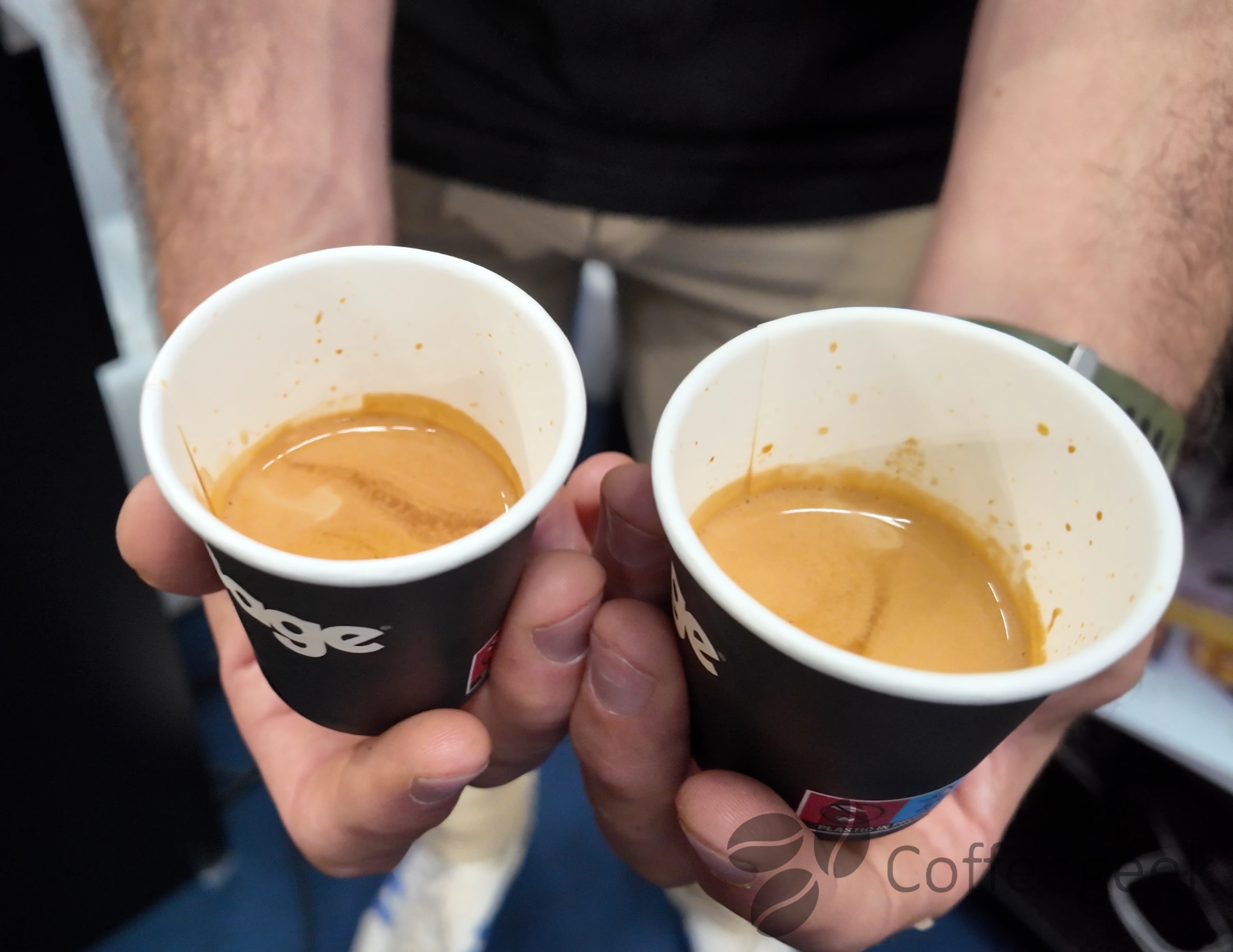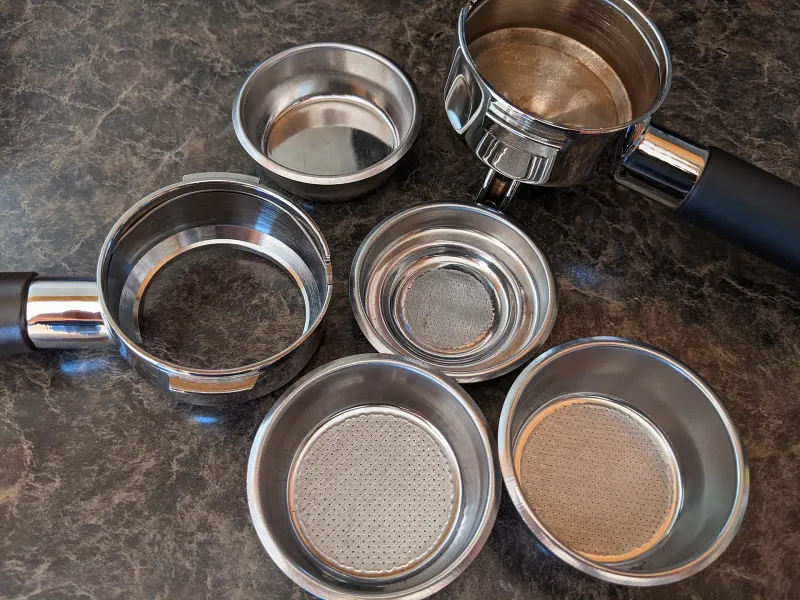

Same coffee, same recipe: one shot tastes bright and juicy, the other round and jammy. The difference can come from a thin piece of steel under the puck: the filter basket.
Italian basket maker IMS-Filtri builds two of its baskets on opposite ideas. The Big Bang pulls water toward the centre; the Cylindrical NT spreads it evenly. Together they show how basket design tilts the balance between acidity and sweetness.
Here is what basket shape changes in the cup, what other high-end baskets offer, and how to redial your grinder after a switch.
Is acidity in the bean or in the shot?
Acidity and sweetness are not fixed in the bean. They depend on how the coffee is extracted, and the basket is part of that. In espresso, the sweetness you perceive owes more to body, oils and crema than to dissolved sugar. A heavier, thicker shot tastes sweeter.
Tiny doses count: in a lab test on a wine-style drink, just 0.1% phospholipids (a type of fat) changed taste and texture. More oil in the cup feels rounder; less turns it dry.
Backed by sweetness and body, acidity reads as freshness. Without that support, in an under-extracted shot, it turns harsh.
The test: let the shot run longer. Sour notes that fade while sweetness climbs point to under-extraction. Acidity that holds and blends in belongs to the coffee.
How does a basket steer the water?
The coffee bed still provides most of the resistance. But the number, pattern and finish of the holes decide where water leaves the puck. Water naturally runs faster along the wall. When it channels, it rushes through a few paths and extraction stays low.
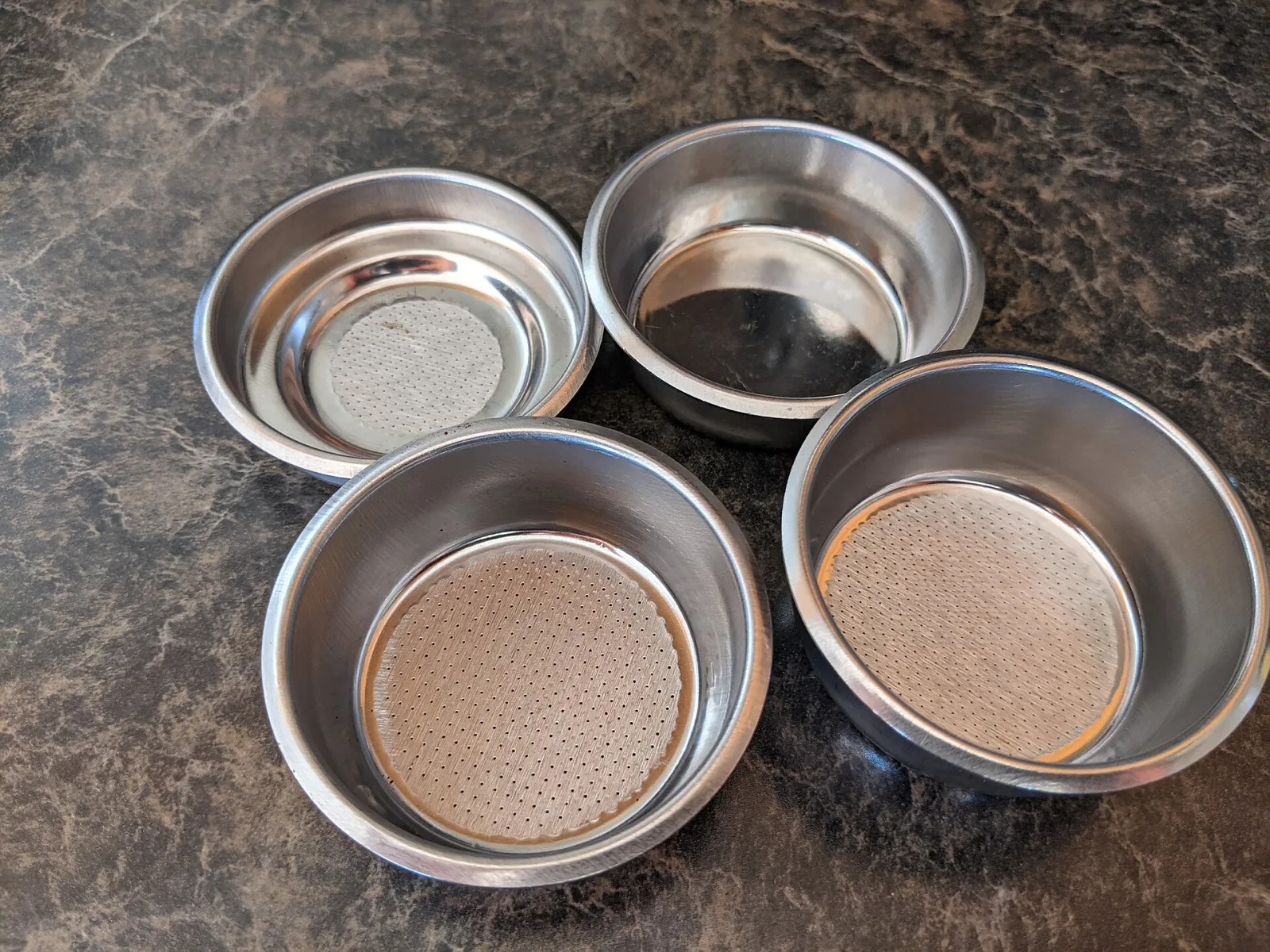
On the Italian maker's baskets, holes are conical, wider at the bottom than the top, 0.25 to 0.40 mm across. Patterns go from up to 481 holes spaced 2.00 mm apart to up to 715 holes on a 1.73 mm hexagonal grid, both within a 49 mm diameter.
Shape counts too: tapered walls leave loose coffee at the edges, which invites channelling down the side. The maker's competition baskets use straight walls for 58.4 or 58.5 mm tampers, with flat or convex bottoms. Home machines face the same logic, as our Quickmill Pop basket mod shows.
4 tips to avoid channeling with a bottomless portafilter
Discover how to avoid channeling during your espresso extractions with a bottomless portafilter.
Read the article →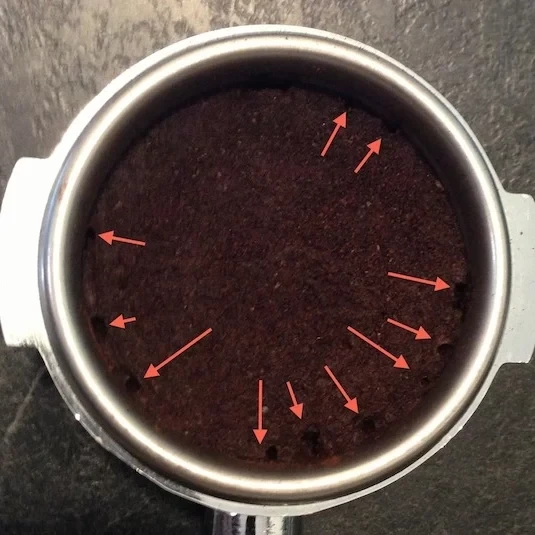
Big Bang: why pull the flow to the centre?
The Big Bang spaces its holes 1.5 mm apart at the centre, then wider toward the edge, like an explosion. It has up to 585 holes within a 49 mm perforated diameter. Walls are straight, the bottom flat, the finish electropolished. Its 70 mm border fits 58 to 58.4 mm tampers and machines with an E61-type group head.
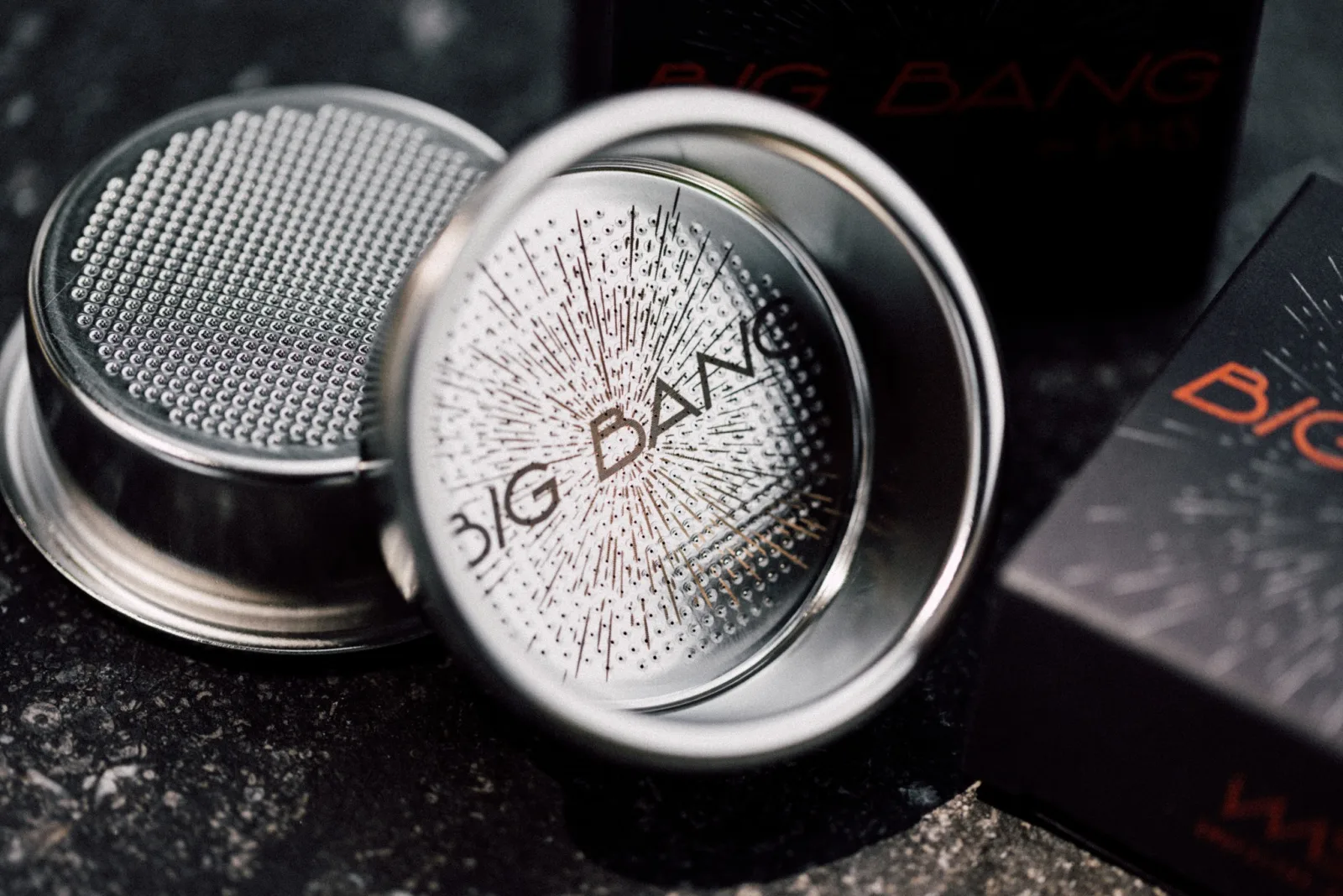
Fewer edge holes leave less room for water to escape where it already flows fastest. The idea is a centred stream that forgives small prep errors. Davide Spinelli, who trains Q Graders (certified coffee tasters), stays measured: "The Big Bang doesn't eliminate channelling caused by poor prep, but it dampens its effect in the cup."
The goal in the cup: a rounder body and more perceived sweetness, with the same recipe. Fruit notes turn jammy rather than fresh. The smaller open area also shifts shot time. The 23.5 mm version takes 17 to 19 g of dark roast, 18 to 20 g of medium and 19 to 21 g of light.
Cylindrical NT: more clarity, less forgiveness
The Cylindrical NT shares the Big Bang's 58 mm base and 49 mm perforated area, but does the opposite. Its holes are spread uniformly, so water exits evenly across the base. The aim: more clarity and a more defined acidity.
The trade-off: a thin patch, a loose edge or a clump gives the water an easy exit. Precise prep gives a clearly defined cup; small flaws show straight away.
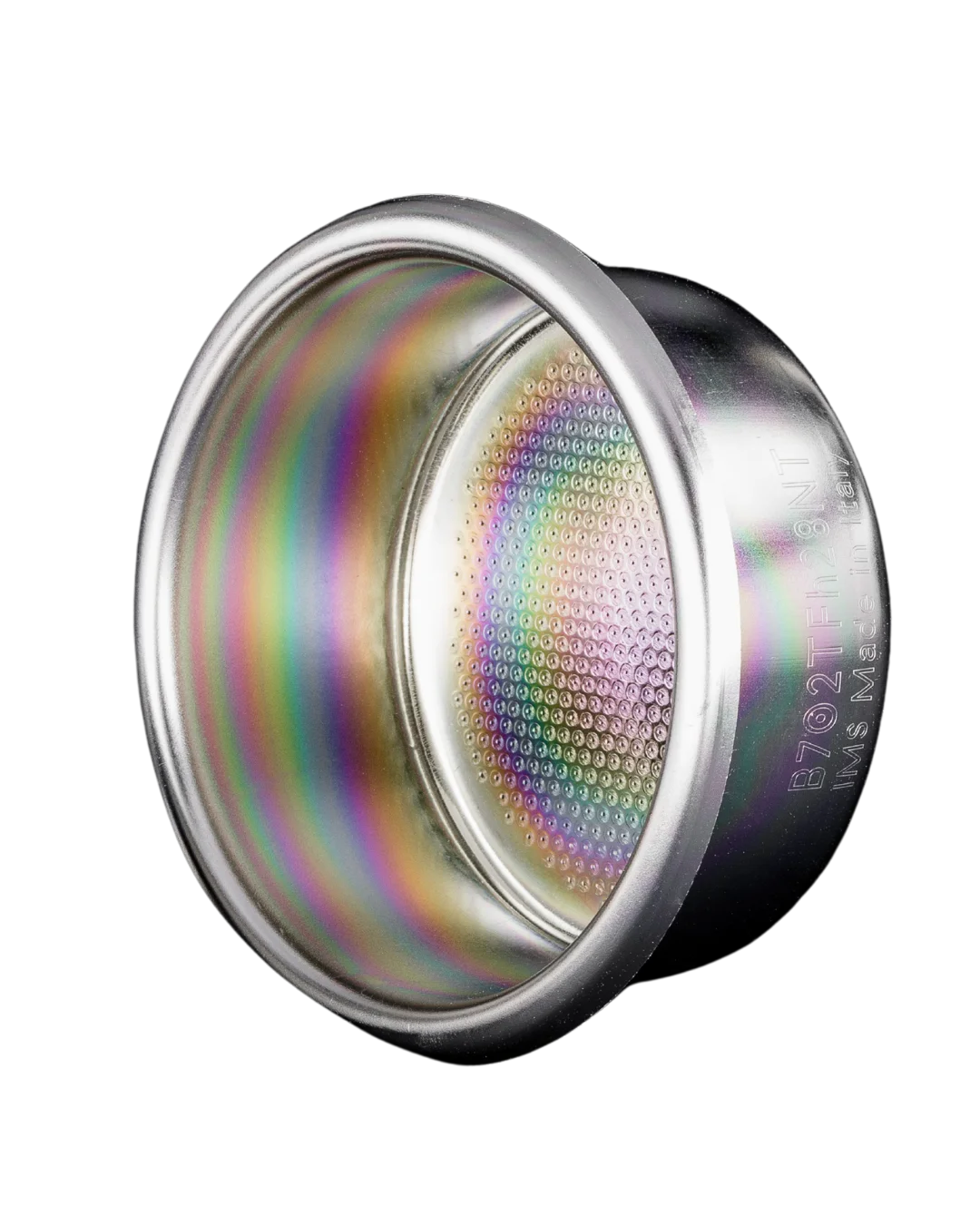
The NT also carries a Nanoquartz coating, a quartz layer that is water-repellent and non-stick. It resists corrosion and oil build-up, and pucks knock out easily.
Beyond IMS: what do VST and WAFO do differently?
IMS is not the only maker of precision baskets. VST spreads its holes across the whole floor. Each one is micro-machined, then measured: size must stay within ±30 µm, and total open area within ±5% from one basket to the next. Every basket carries a 2-D code holding its own factory data, and is rated for 100,000 cycles.
VST baskets are usually plain stainless steel, with or without the ridge that clips them into the portafilter, for 58 mm portafilters. Each size suits one dose: 15 g (22 mm deep), 18 g (24.2 mm), 20 g (26 mm) or 22 g (28 mm). The deepest often need a bottomless portafilter; on a spouted one, check that the base clears the spouts.
WAFO takes another route. Australian distributor Barista Group planned to launch the baskets in Australia at the Melbourne International Coffee Expo in March 2025. The baskets have a slightly flattened round shape. The SOE series aims for even extraction; its Spirit model has 2,916 elongated holes.
The BLEND series extracts unevenly on purpose, with asymmetric patterns, and the Solar System series places holes off-centre. They open the door to longer ratios, 1:2.5 or 1:3 instead of 1:2, but need an ultrasonic cleaner.
How to compare? Look past the logo to the model itself: dose, depth, ridge, hole layout and coating. Expect to regrind after fitting a VST, and do not count on precision alone for a sweeter cup.
Switching baskets without losing your recipe
A new basket changes flow rate, so the grind must move to keep shot time steady. Our grind size guide covers the basics; then:
-
Lock everything except the grind: dose, yield, temperature and puck prep stay as they are.
-
Match the basket height to your dose, so the gap above the puck stays about the same.
-
Pull a first shot without touching the grinder, and see how far its time lands from your target.
-
Correct in small steps, one change at a time; it rarely takes more than three shots.
-
Confirm with a refractometer, which measures dissolved solids, and a tasting.
The classic mistakes: blaming the basket for a few seconds of brew time, or changing the dose to make up for it. That is a new recipe, not a basket test.
Which one, then? The NT is meant for a balanced coffee drunk neat, with berry or floral acidity. The Big Bang is the suggested fix when acidity pricks, when the roast is very fresh, or for milk drinks.
A basket fine-tunes a good shot but cannot rescue a bad one
Puck preparation still comes first: even distribution, a level tamp and a clean basket. No basket makes up for them. Our 4 tips to avoid channeling are the first step.
With good prep in place, the basket becomes one more dial: it changes flow and taste while the coffee stays the same. Next to a new machine or a new blend, it is by far the cheaper change.
One caution: no side-by-side measurements of dissolved solids (TDS) have been published for these baskets. The sweeter-or-brighter effect remains a design goal, not a proven result. To judge for yourself, use two baskets, a refractometer and a blind tasting.
Going further
Barista Tip: Distributing Coffee Grounds in a Portafilter
Learn to properly distribute grounds in your portafilter to avoid channeling. Barista techniques and tool recommendations for consistent espresso.
Read the article →
Timemore PUCKS: Is the 3-in-1 Espresso Set Worth €209?
Timemore PUCKS tested: calibrated tamper, distributor, and orbital WDT tool in a €209 set. Does Timemore deliver on quality?
Read the article →