
A small porcelain cup, a glass of water, a piece of Turkish delight. Under a thick layer of foam, coffee ground as fine as flour, never filtered. Turkish coffee looks simple. Yet this cup carries nearly five centuries of history: sultans who feared it, brides who salted it, fortune-tellers who read its grounds.
In 2013, UNESCO inscribed the culture and tradition of Turkish coffee on its list of the intangible cultural heritage of humanity. Here is how a drink from Yemen became an Ottoman ritual, how it is made in a cezve, and what it still means around a table today.
It is also one of the most demanding ways to brew. No other method calls for a finer grind, the grounds stay in the cup, and the heat must be watched to the second to keep the foam. In Turkey, it still shares daily life with tea.
How did coffee reach Istanbul?
The coffee tree grew wild in the rainforests of Ethiopia. It was first cultivated commercially in Yemen, where people may have been the first to drink coffee as a hot beverage. Its first regular drinkers were probably Sufi mystics keeping night vigils.
In the 16th century, the drink travelled through the Islamic world. It went from the Hijaz to Cairo, then from Cairo to Syria and Istanbul. After the Ottomans conquered the Mamluk Sultanate in 1517, coffee spread around the Levant.
On the way, the Arabic qahwa took the Turkish name kahve. That word gave us the English "coffee".
The empire also held the source. From 1538 to 1636, the Ottomans controlled the southern coast of today's Yemen, including the coffee port of Mocha.
By 1539, coffee was already in use in the capital. A legal document mentions a coffee chamber in the house of admiral Barbaros Hayreddin Pasha. The first coffeehouse appears to have opened in 1554, in the Tahtakale district. Two Arab merchants, Hakem of Aleppo and Şems of Damascus, founded it.
The success was immediate. Coffeehouses spread all over Istanbul and reached small Anatolian towns. An Armenian historian counted over 600 of them fifteen years after coffee arrived in the city.
Brewing well was not easy then. Prominent Ottomans kept specialist coffee cooks. Suleiman the Magnificent had a kahvecibaşı, a chief coffee-cook, and the post became a tradition at court.
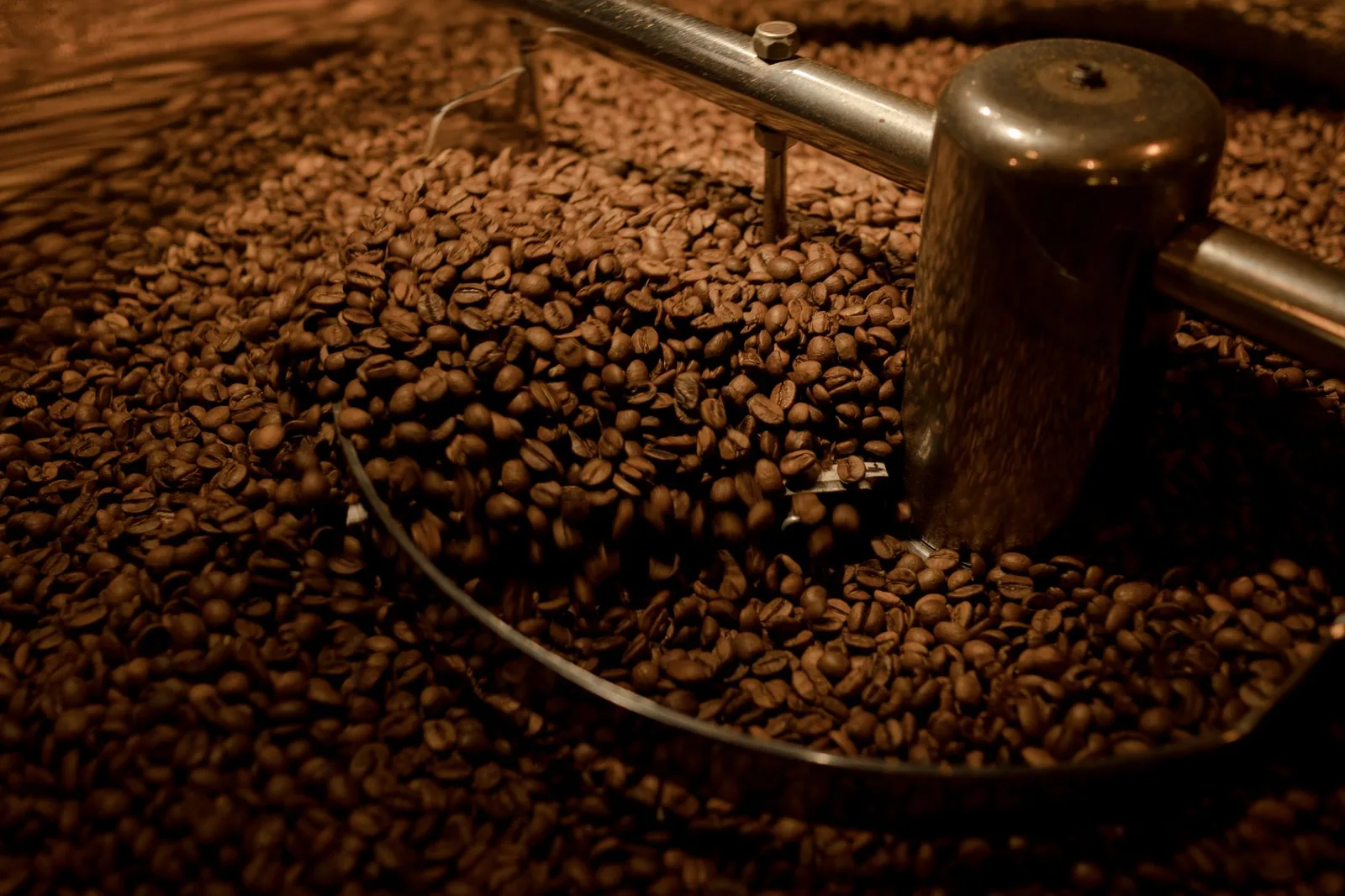
The method also changed the drink itself. The Arabian qishr, made from the lightly toasted whole husk, was a pale, spiced liquor. In Turkey, the beans were blackened over a fire, ground to a fine powder and boiled several times.
Why did the sultans fear the coffeehouse?
The kahvehane gave Muslim men something new. Apart from the mosque, it was their first public space to socialise, since their religion forbade alcohol. Before it, people met at home, at work, at the market or at the mosque. Now they had a place to gather, talk and debate.
Inside, social rank faded. Patrons sat on long benches in order of arrival. Men of all classes met as equals, heard storytellers and musicians, and traded news and gossip. The historian Uğur Kömeçoğlu sees there an early "public sphere", born before Europe adopted the coffeehouse.
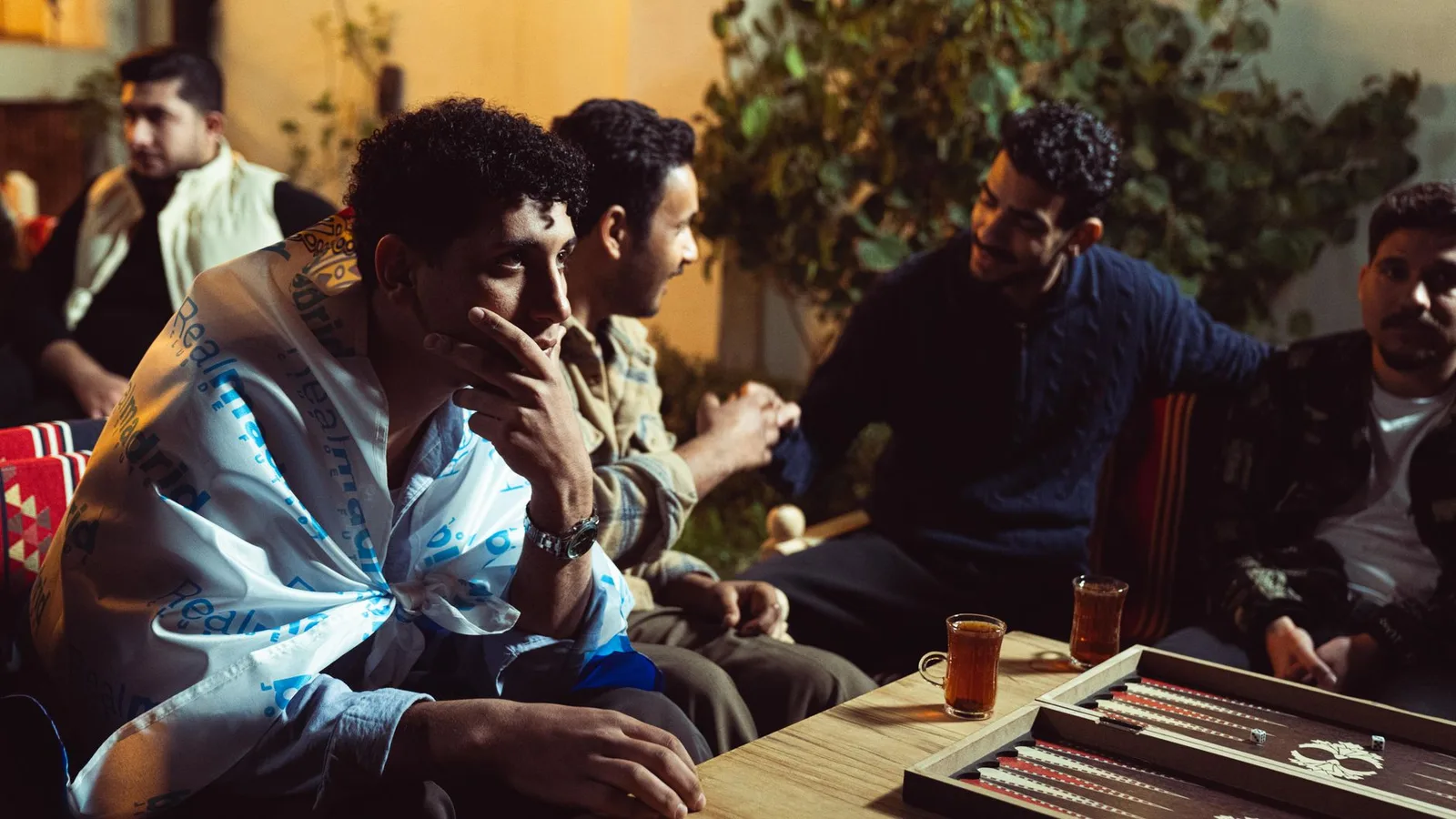
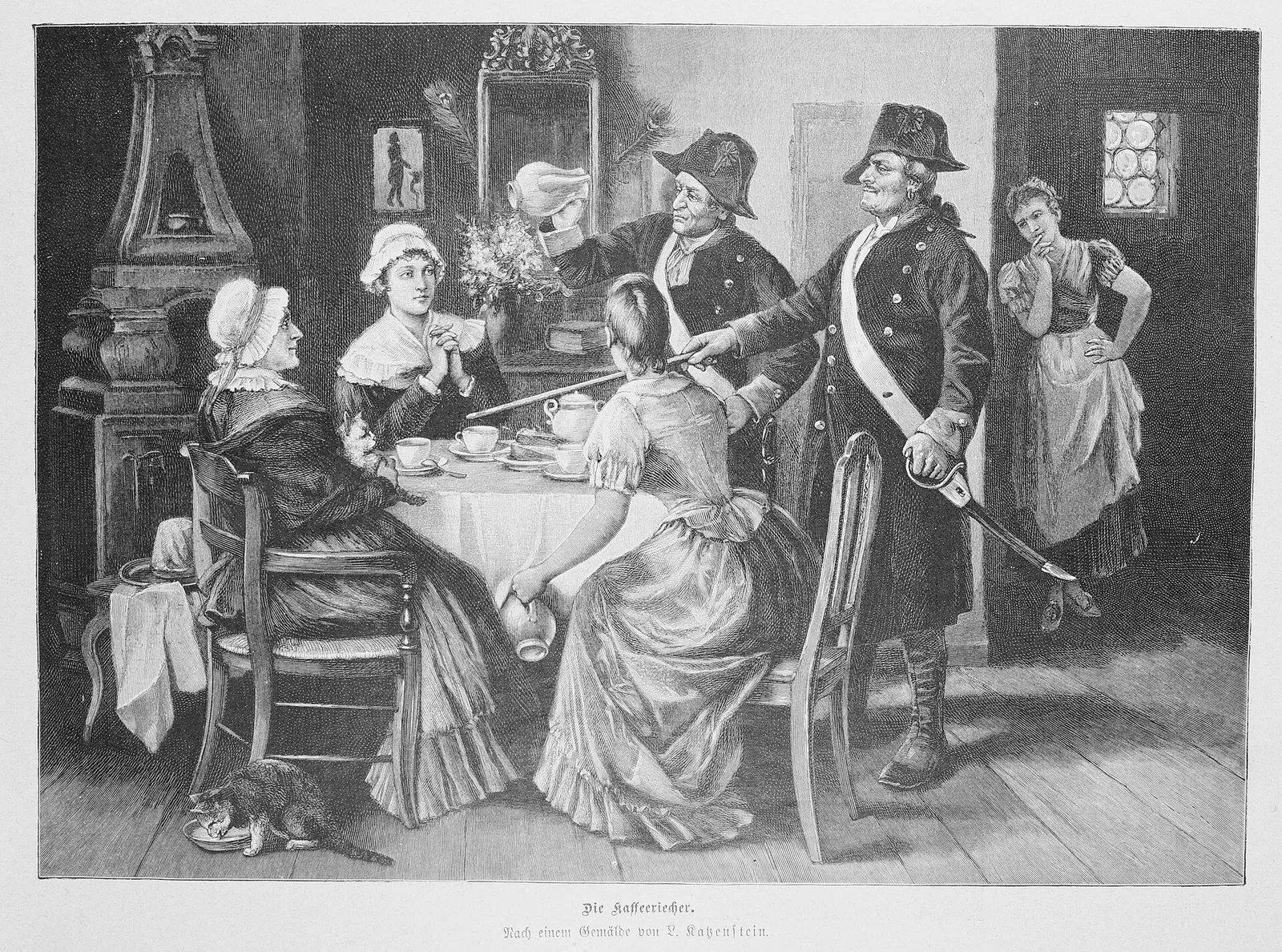
That freedom worried those in power. What rulers condemned was not caffeine but free talk, which they saw as subversive. As early as 1543, ships were ordered to be sunk in Istanbul harbour for importing coffee. Murad III, then Ahmed I, tried to eradicate coffeehouses.
Murad IV went furthest. He had all coffeehouses torn down and banned tobacco too. Anyone caught keeping a coffeehouse was cudgelled the first time. The second time, he was sewn into a bag and thrown into the Bosphorus.
The bans never held. Local officials often "overlooked" orders. Taxing the coffee trade proved more profitable than fighting it. Policing was too costly, and coffeehouse owners gave generous donations to their local mosques.
The bans finally ended in the late 1600s, after more than 150 years of religious and secular unease. Much later, Atatürk's government again discouraged village coffeehouses as places to waste time.
How is Turkish coffee made?
Everything starts with the grind. The powder must be clearly finer than espresso. Particles of 75 to 125 microns shape both the foam and the mouthfeel.
A traditional brass mill with steel burrs is more common, or a hand grinder able to go that fine; most electric home grinders cannot. Ready-ground coffee exists, but such a fine powder goes stale quickly.
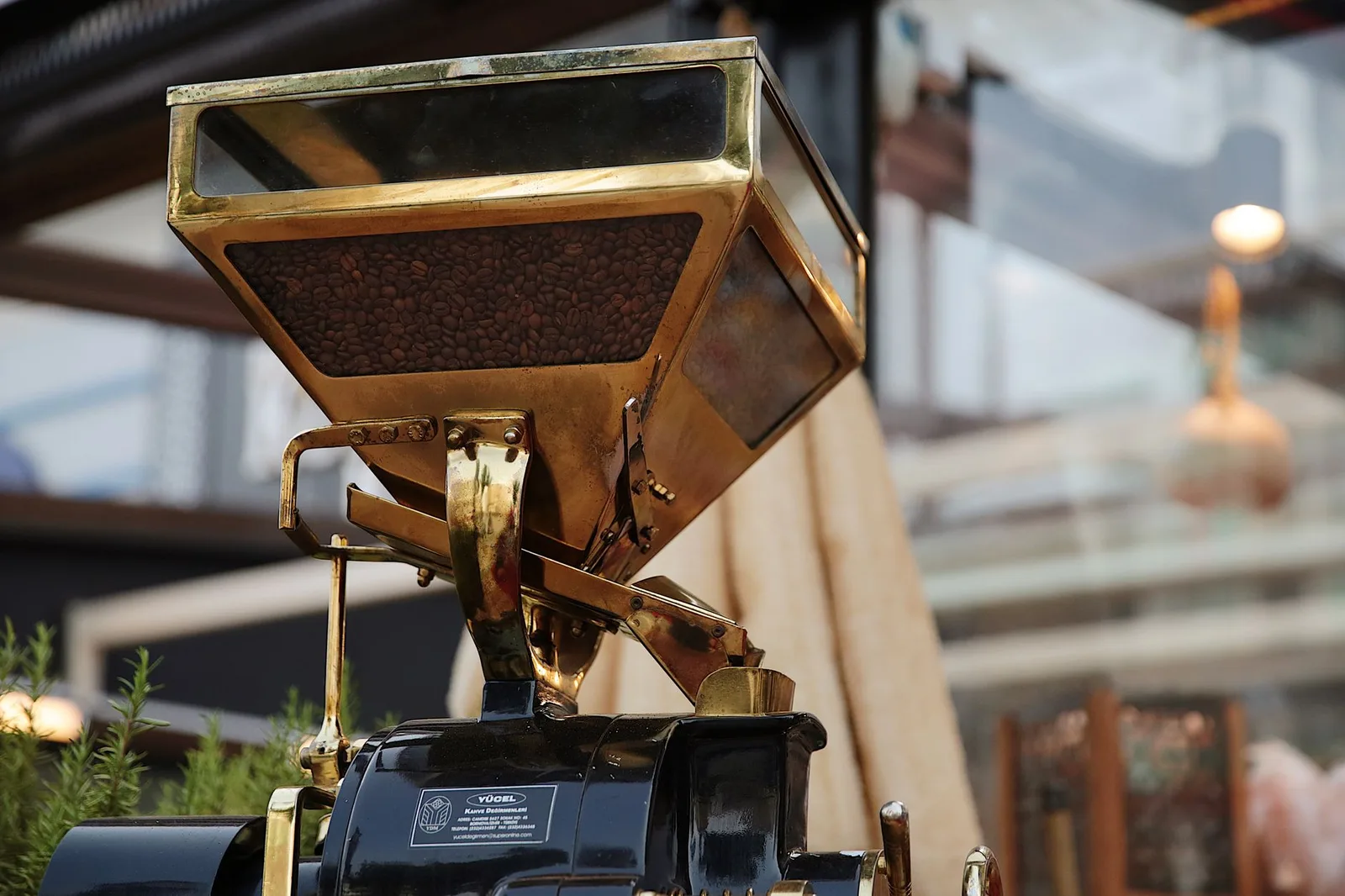
There is no special Turkish bean. Arabica is considered best, though robusta and blends are used too. Such a fine grind extracts intensely, so a medium or medium-dark roast works best.
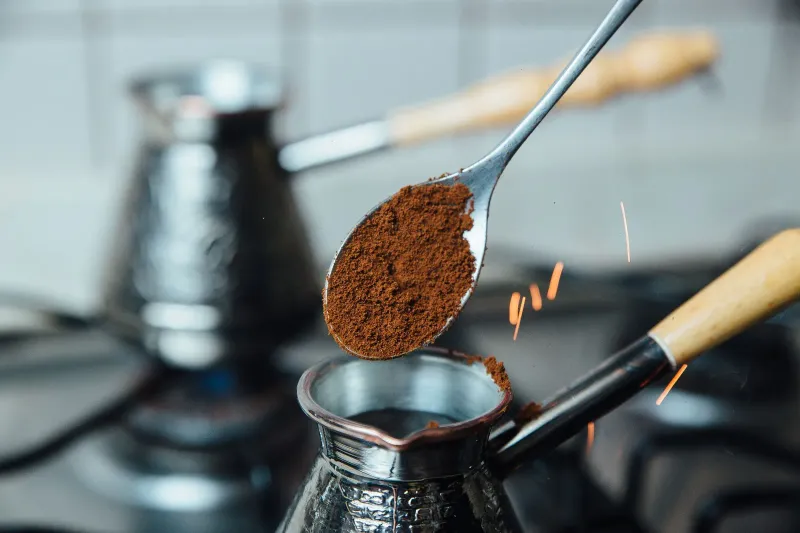
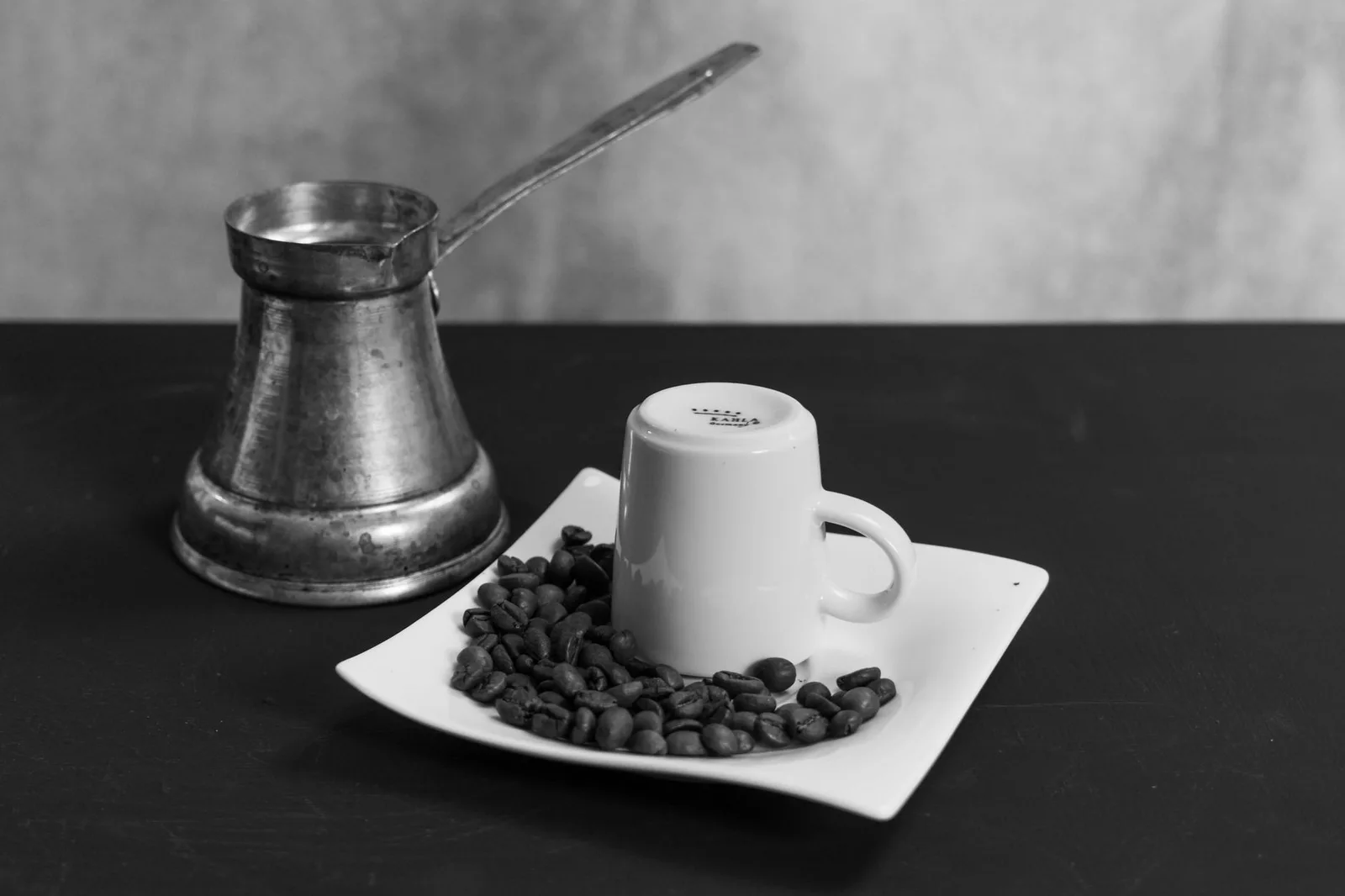
Then comes the cezve, also called ibrik. It is a long-handled pot, traditionally in thick forged copper lined with tin, or in brass; steel is common today. It is wider at the base than at the neck, with a pouring lip. That tapering shape helps foam form and keeps the aromas in.
The brewing itself takes a few minutes:
-
Measure water, coffee and sugar
For one cup, put 60 to 70 ml of cold water, 6 to 7 g of coffee and sugar, if wanted, into the cezve.
-
Break up the clumps
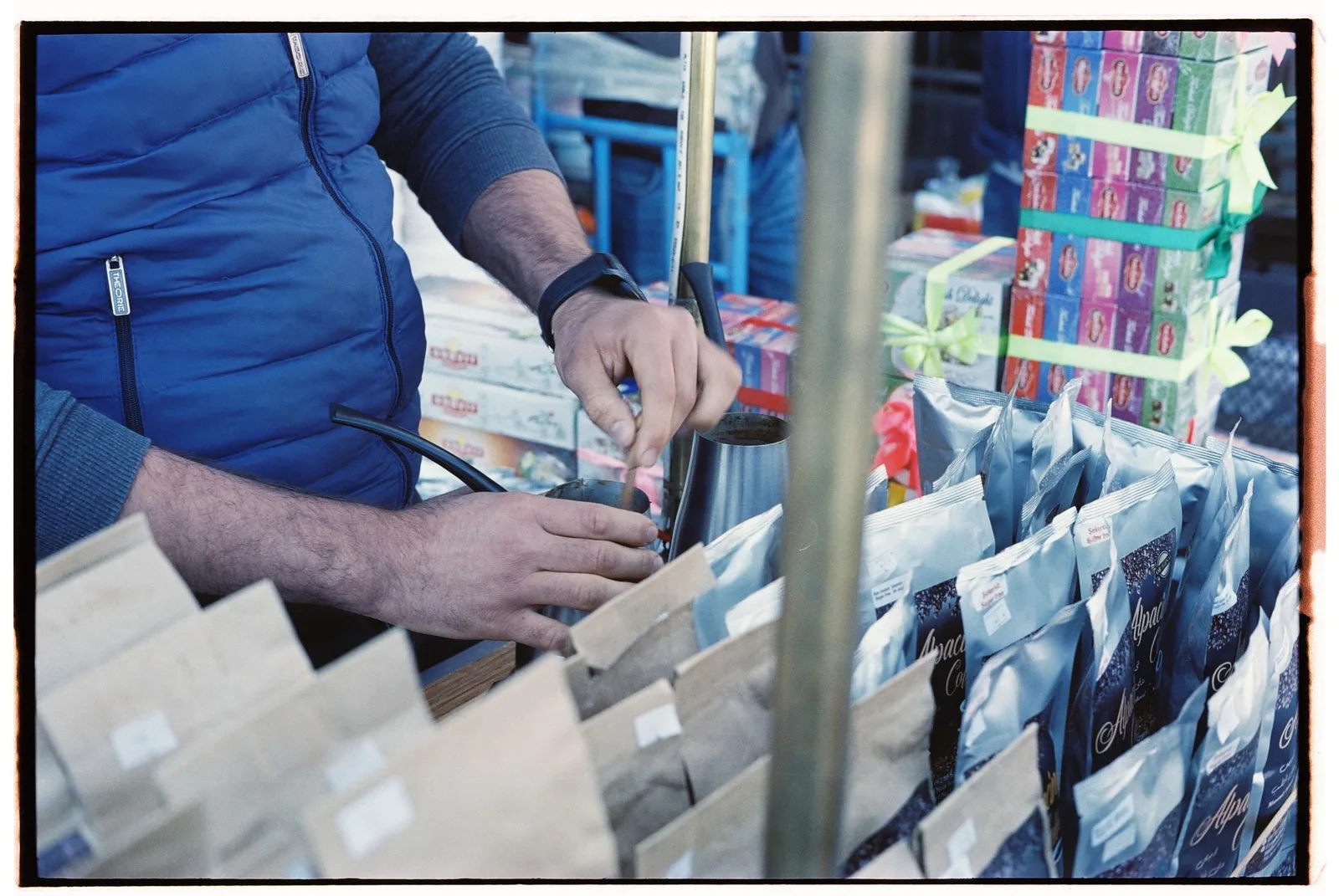
Such a fine powder tends to form clumps once the water is in. Before heating, it is recommended to stir it with a WDT tool or another thin tool. All the coffee is then evenly wetted.
-
Heat gently, without stirring
Once the pot is on the heat, leave it alone. Take it off just before the boil, when the foam rises.
-
Watch the foam
A good cup has the thickest possible froth. Some traditions let it rise two or three times, but one is enough: longer boiling can kill the foam and add bitterness.
-
Serve in two pours
Pour a little foam into each cup, return the pot to the heat, then pour the rest.
Unfiltered, Turkish coffee is a decoction: much of the powder stays in suspension and is drunk, while the rest settles at the bottom.
Sugar goes into the pot, so you choose it when ordering: sade (no sugar), az şekerli, orta or çok şekerli (sweet).
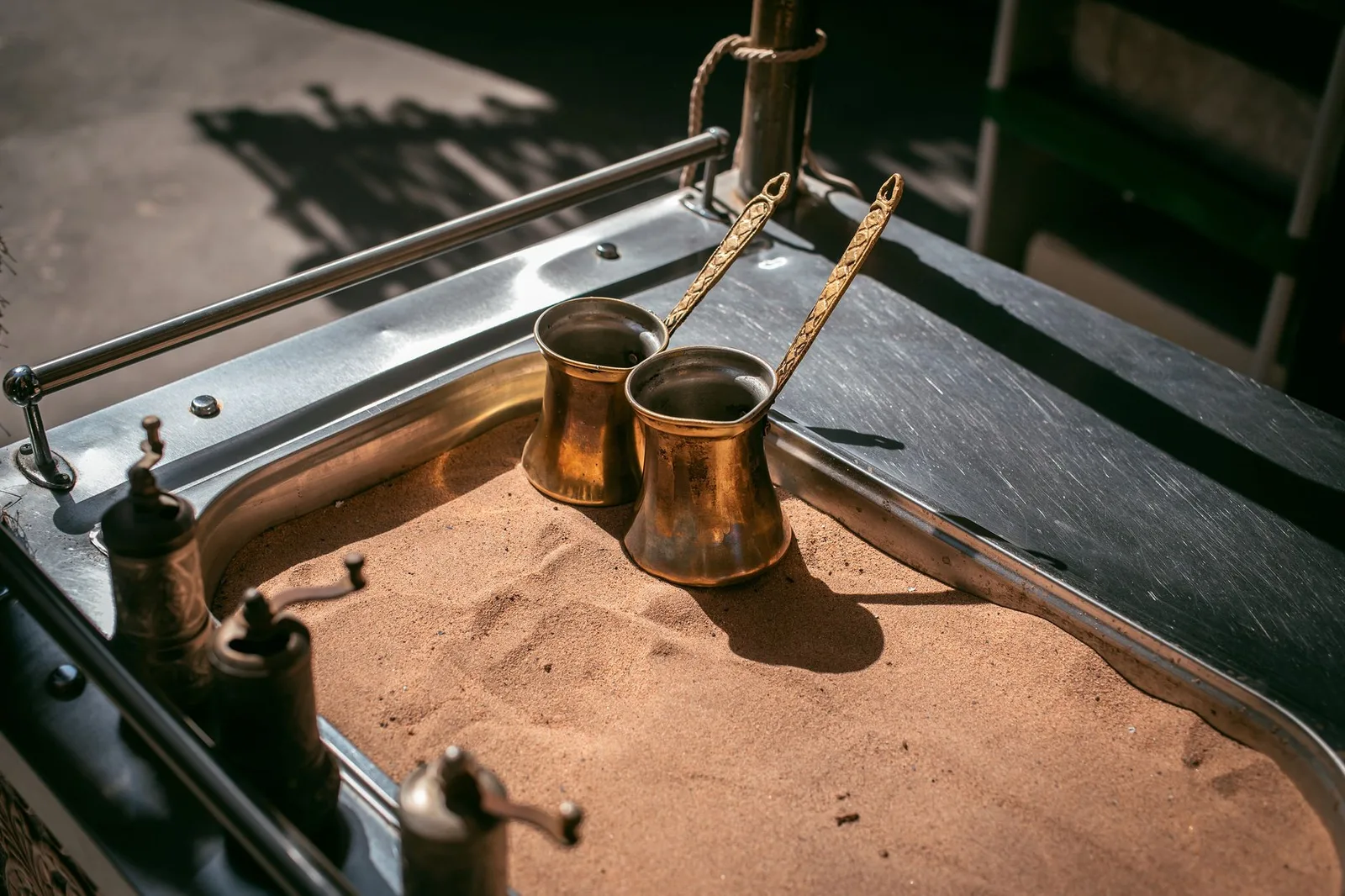
Another technique sets the cezve in a pan of hot sand heated over a flame. The sand evens out the heat, and burying the pot more or less deeply sets it.
Turkish coffee does not always hold more caffeine than an espresso. But with no filter, it keeps the diterpenes, natural coffee oils that can raise LDL ("bad") cholesterol in some people when consumed in large amounts.
Hospitality, marriage, friendship: the social life of a cup
The cup is served in a kahve fincanı of about 90 ml, traditionally porcelain. Fine cups often pass down through families. A glass of water comes first, to cleanse the palate, often with a lokum, or Turkish delight.
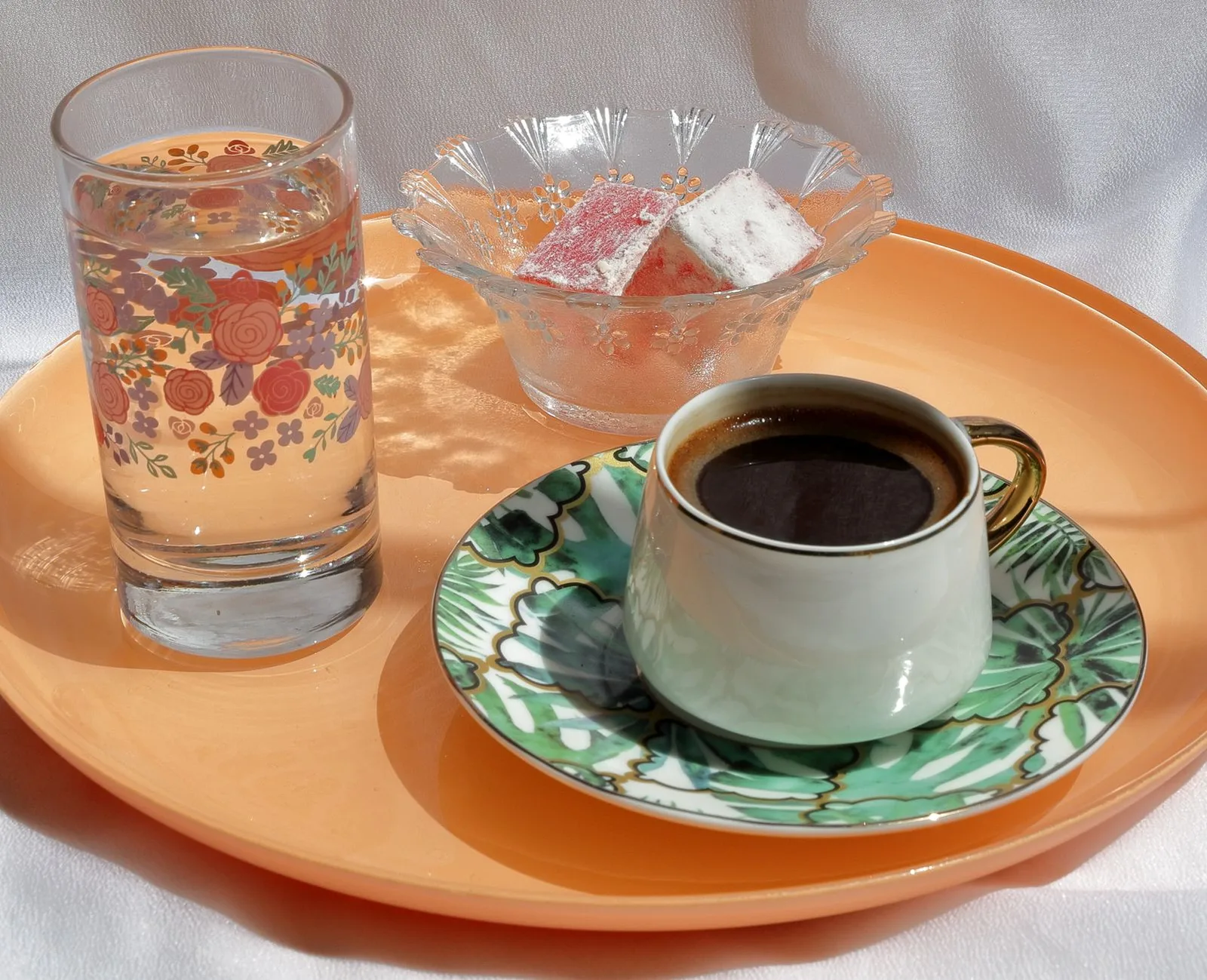
The drink stands for hospitality, friendship and refinement. Coffee has always been a pretext for conversation. An invitation to coffee is a chance to confide or share daily worries.
People drink at least one cup a day. Each moment has its own coffee: sabah kahvesi in the morning, keyif kahvesi for pleasure, yorgunluk kahvesi when tired. A Turkish proverb says one cup creates forty years of friendship. In Anatolia, a "coffee of friendship" settled quarrels.
The cup also plays a part in engagements. When the groom's parents come to ask for the young woman's hand, she prepares and serves the coffee. It was often the couple's only chance to meet. If she liked him, the coffee was sweet; otherwise, she salted it.
The salt can also test his character or his feelings: drinking it without a grimace proves his patience. In some regions, a cup with no froth means "You have no chance!" The meaning varies by family and region.
In Manisa, cilveli coffee, foamy and topped with double-roasted ground almonds and two spices, was once made for princes. Young women offered it to show approval of a suitor.
Once the cup is empty, the grounds have one more role. In tasseography, the cup is turned over onto its saucer. The grounds run down for a few minutes and set into patterns, which are then read.
Women ask for readings more than men, often about love, marriage or children. Apps such as Falaaddin now even read photos of the grounds.
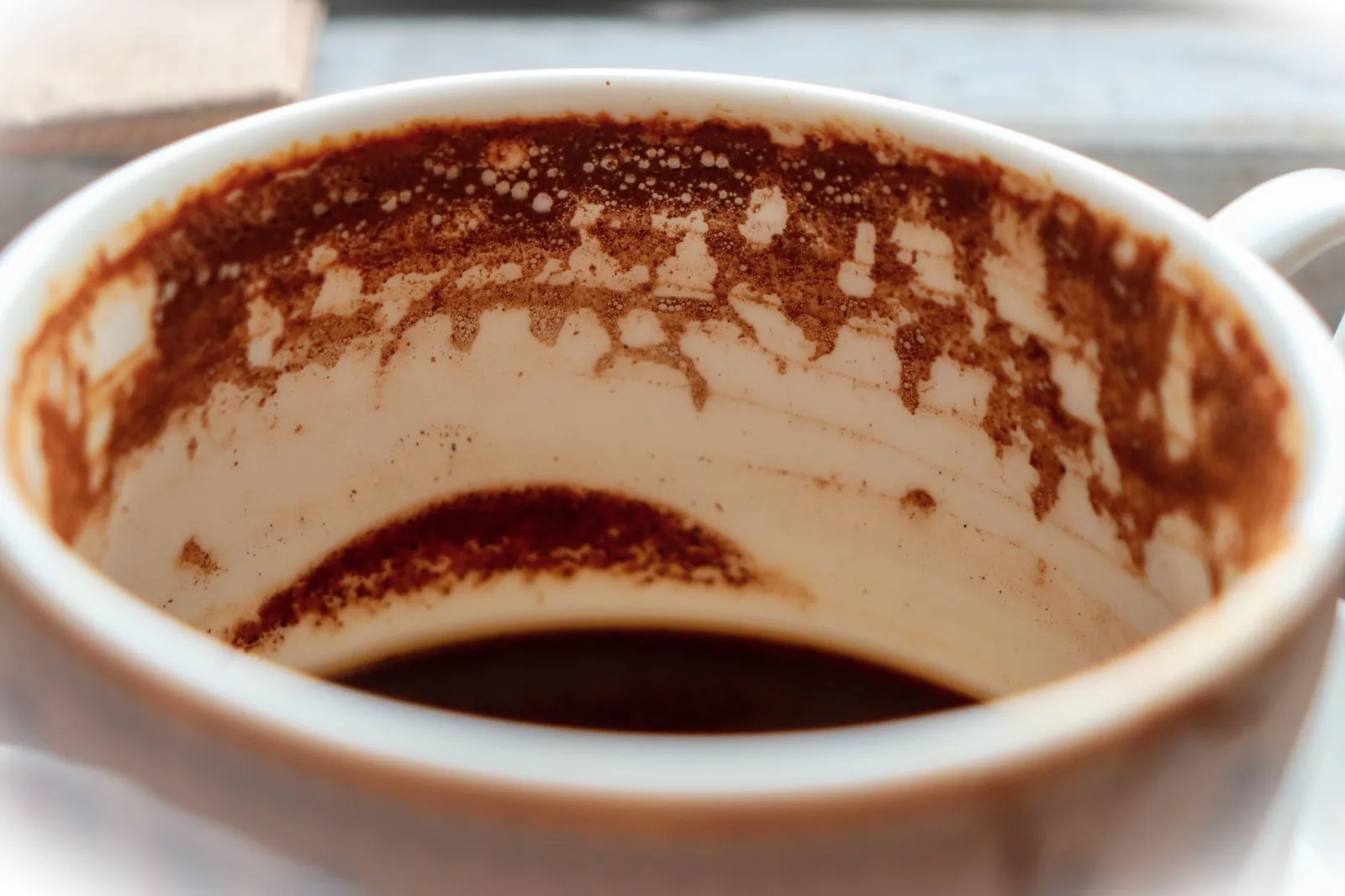
All this knowledge passes informally within families, by watching and taking part.
One drink, many names: from Venice to Yerevan
From the Ottoman Empire, coffee probably reached Western Europe first through Venice, where it was taken as a medicine. Travellers brought it home for their own use; Jean de Thévenot even imported authentic ibriks. Most Europeans disliked the black, bitter Turkish cup, and it was costly: in France, beans sold for the equivalent of US$8,000 a kilo.
The first European coffeehouses opened in England in the 1650s. France and Germany followed about twenty years later, Austria and Italy over thirty years later. Vienna had its first coffeehouse in 1685.
Coffeehouse keepers sold the "Turkish" image with turbans and "Turk's Head" signs. Yet coffee only became a European favourite once it was diluted with milk and sweetened.
Across the Middle East, North Africa, the Caucasus and the Balkans, the drink goes by many names. Some names are politically disputed.
- Greece: once simply "Turkish", it became "Greek coffee" after tensions in the 1950s, and more so after 1974. The pot is a briki on the mainland, a tzisves in Cyprus.
- Bosnia and Herzegovina: bosanska kahva is made slightly differently: a little of the boiling water is set aside.
- Serbia: srpska kafa, domaća kafa or just "coffee".
- Armenia: haykakan surč or sev surč, "black coffee", mainly set apart by cardamom. Armenians also brought it to Corfu, never Ottoman, where it is "eastern coffee".
- Czech Republic and Slovakia: turek is made by pouring nearly boiling water over ground coffee, in pubs, kiosks and homes.
The cezve still dominates at home and in rural coffeehouses across the former Ottoman lands, while espresso gains ground in cities. Turkey and Egypt alone count more than 150 million coffee drinkers.
Legends and anecdotes
The governor of Yemen
A legend says an Ottoman governor posted in Yemen grew fond of coffee and brought it to the palace kitchen, under Suleiman the Magnificent. Coffee in fact reached Istanbul through Cairo and Syria.
The sacks left at Vienna
Another popular tale says Ottoman troops abandoned sacks of coffee after failing to take Vienna in 1683, introducing coffee to Europe. It does not hold: England already had coffeehouses in the 1650s, three decades before the siege. In the 1680s, Franz Georg Kolschitsky, who promoted murky stories about his role in relieving the siege, opened the Blue Bottle coffeehouse in Turkish dress. A statue on Favoriten Strasse shows him pouring from an oriental pot.
An ambassador in Paris
One story has Suleiman Aga, Mehmet IV's envoy to Louis XIV, arriving in 1669 with enough coffee to serve Parisians. Paris's first coffeehouse followed in 1671.
From Ottoman court to UNESCO list: the Turkish cup today
In 2013, UNESCO inscribed the culture and tradition of Turkish coffee on its Representative List of the Intangible Cultural Heritage of Humanity. The listing honours both the preparation and the shared culture around it: literature, songs, ceremonies. It recognises the drink as one of the pillars of Turkish cultural heritage.
That recognition came after hard times. In the 20th century, especially in wartime and the 1950s, coffee was scarce for years or cut with chickpeas. The old culture declined.
Today, Turks drink more tea than coffee, and the most popular brand is instant Nescafé. By 2018, Istanbul alone reportedly had over 400 Starbucks, and young Turks were turning to third-wave coffee.
The cup still holds its place next to tea. In Eminönü, at the entrance to the Egyptian Bazaar, Kuru Kahveci Mehmet Efendi draws queues. Opened in 1871, it innovated by selling coffee already roasted, when Turks bought green beans and roasted them daily.
Turkish coffee is rarely used for specialty coffee, yet with careful heat control it can give full-bodied, complex cups. All you need is a cezve, a grinder fine enough and a fresh medium roast.