

A spoon, some hot water and a few seconds are all it takes. Instant coffee is probably the most widely consumed caffeinated drink in the world, and yet it rarely comes up in specialty coffee circles, as if it belonged to another category, almost off-topic. But its history is far richer than you might think, blending chemistry, colonialism, military logistics and, more recently, an unexpected artisanal renaissance.
The origins: a Japanese chemist in Chicago
The story of instant coffee begins in 1901, barely seventeen years after Angelo Moriondo invented the espresso machine. Satori Kato, a Japanese chemist working in Chicago, filed the first patent for a process that produced soluble coffee stable at room temperature. The idea is simple to state and complex to carry out: extract liquid coffee, then remove all the water to leave a powder or granules that redissolve instantly.
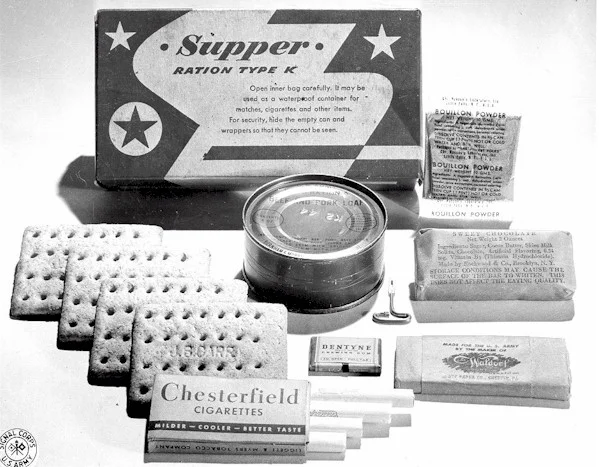
At the time, the motivation wasn't gastronomic. It was above all practical and logistical. Armies, explorers and construction workers needed coffee, but not the ritual that goes with it. Instant coffee met a demand for absolute convenience, in a world where speed was starting to matter more than quality. World War I would greatly accelerate its adoption: American soldiers received rations of soluble coffee as early as 1914, which helped normalize drinking it on a large scale.
It wasn't until 1938 that Nestlé launched Nescafé, the product that truly brought instant coffee to the masses worldwide. Initially developed to help Brazil sell off its green coffee surpluses, Nescafé became the world's best-selling coffee within a few decades. The brand didn't invent the process, but it managed to industrialize it, make it accessible and, above all, turn it into a cultural object in its own right.
Industrial production: an impressive operation
Understanding how instant coffee is made on a large scale shows you the gap between this drink and what you brew at home, and why that gap has long meant compromising on quality.
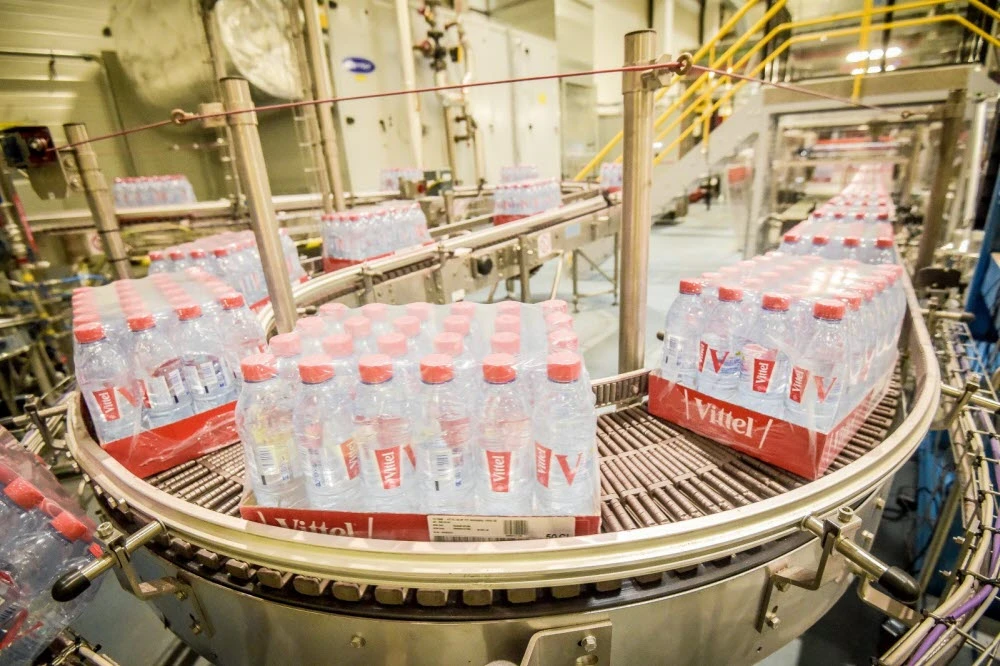
In a modern factory, 70 metric tons of green beans can arrive every day. The beans are roasted at around 200°C in industrial rotating-drum roasters, then coarsely ground before undergoing pressurized steam extraction. In one hour, these plants can produce up to 18,000 liters of liquid coffee. This concentrate is then processed by one of two main methods: spray-drying (atomization) or freeze-drying (lyophilization).
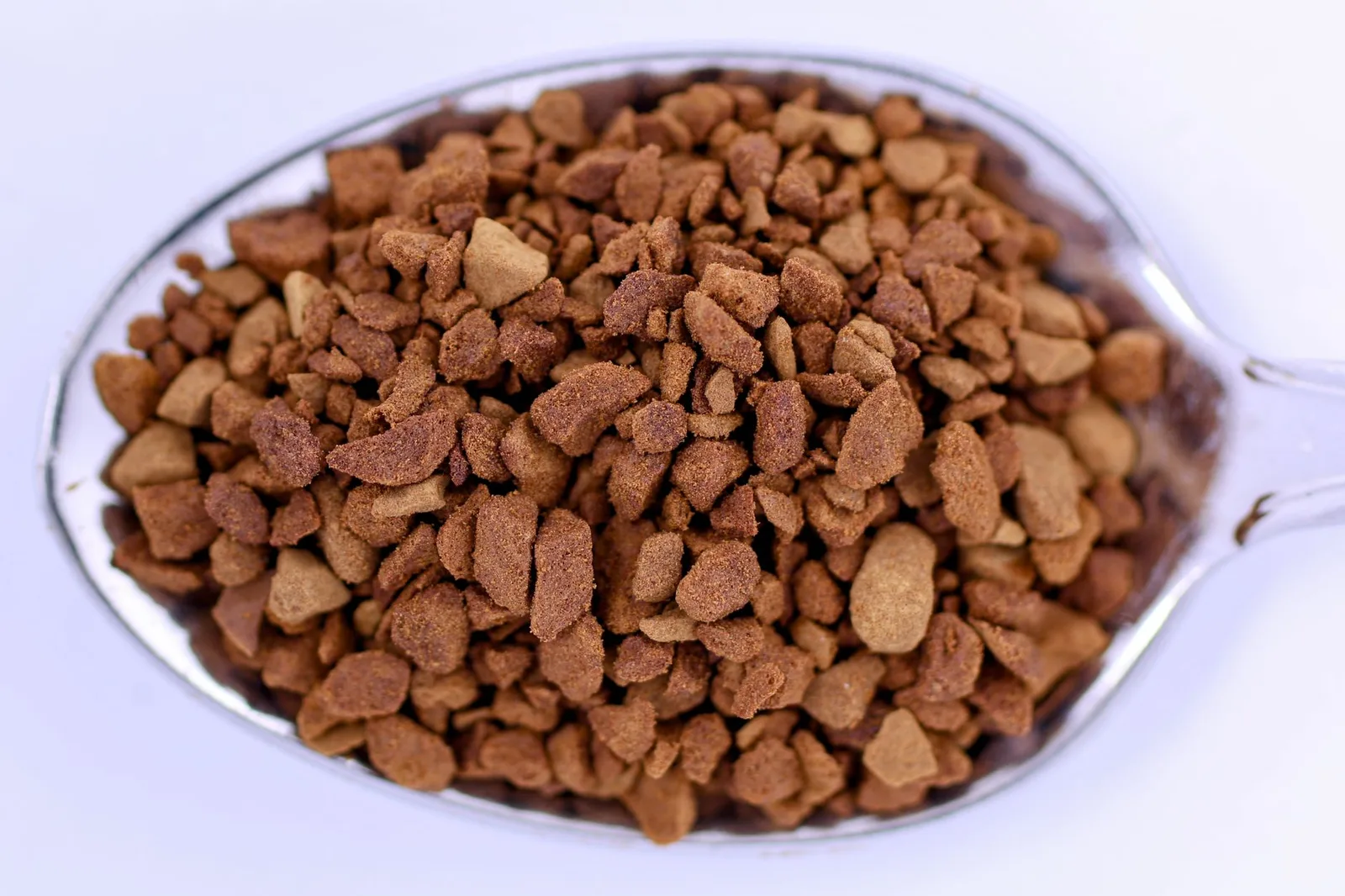
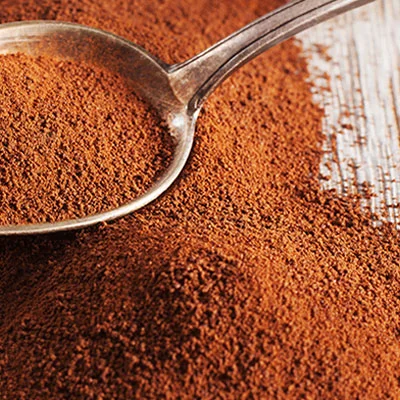
Spray-drying is the faster and cheaper of the two: the liquid coffee is sprayed as fine droplets into a stream of hot air, which instantly evaporates the water. This gives a fine powder, but the high temperatures degrade some of the volatile aroma compounds. Freeze-drying, on the other hand, is far more sophisticated. The brewed coffee is first frozen at temperatures as low as -50°C, then placed in a high-vacuum chamber, at about 0.3 mbar. At this extremely low pressure, the water sublimates directly from solid to gas, without ever passing back through the liquid state. This phenomenon, called sublimation, preserves aromas much better than heat drying. The resulting granules are denser and more fragrant, and they redissolve with a more pleasant texture.
Sublimation is the physical principle at the heart of freeze-drying: under a sufficient vacuum, ice turns directly into vapor without melting. That is what makes it possible to keep the aromas without damaging them with heat.
Freezing speed after extraction is a critical and often underestimated factor. The faster the liquid coffee is cooled after brewing, the better the final result. Industrial producers freeze it directly on refrigerated belts, in a few minutes. Hobbyists who try to reproduce the process at home run up against this constraint: cooling too slowly introduces flavor defects, such as rubbery notes and a flat bitterness, that persist in the freeze-dried product.
A huge cultural impact, and a few paradoxes
Worldwide, instant coffee now accounts for about 35 to 40% of total coffee consumption. In countries such as the United Kingdom, Russia, Japan and Australia, it dominates sales by a wide margin. This is no fringe phenomenon: it's the most widely consumed form of coffee on Earth, ahead of espresso, ahead of filter coffee, ahead of everything else.
This massive success was long seen as a threat by advocates of quality coffee. Industrial instant coffee, made from low-grade Robusta beans and over-extracted to maximize yield, helped give coffee the image of a bitter drink devoid of nuance. It was partly against this image that the third wave of coffee took shape, the movement that put the spotlight on origin, careful roasting and precise brewing methods: everything that specialty coffee is about.
Yet instant coffee holds a fascinating paradox. It is both the product of an industrial logic that sacrifices quality for efficiency and the site of real technical innovation. Freeze-drying is a remarkable technology. And today, specialty roasters use it to produce high-end instant coffee, from single-origin beans that are carefully extracted and quickly frozen. The result is surprising: a coffee that takes thirty seconds to prepare and keeps real aromatic character.
A few roasters now offer freeze-dried instant coffees made from specialty beans. The price per gram is high, a direct result of an extraction yield limited to about 25%, versus more than 50% for industrial producers, but the cup can be genuinely convincing. It's worth exploring if you travel often or want a no-compromise option for the office.
In short
Instant coffee was born of practical necessity, was industrialized on a staggering scale, and is now going through an unexpected renaissance driven by specialty coffee enthusiasts. Its history reflects, in fast-forward, the great tensions running through the coffee world: convenience versus quality, yield versus aroma, accessibility versus individuality. What home freeze-drying experiments show clearly is that the quality of instant coffee depends above all on two factors: the quality of the starting coffee, and how quickly it is frozen after extraction. Industrial producers master these two variables in their own way, and hobbyists can now explore them in theirs.
Instant coffee is not the enemy of good coffee. It's another way of telling the story of good coffee: imperfect, constrained, but surprisingly alive.