
One cup in five. In June 2026, that figure made headlines. It comes from Poison in Your Coffee, a report by a coalition of campaigning NGOs: Coffee Watch, Inkota-network, Deutsche Umwelthilfe and Pesticide Action Network UK. Its exact words are more careful: "1 cup in 5 that coffee drinkers savor is likely contaminated with residues of pesticides."
One French headline dropped the word "likely" altogether. With around 2.2 billion cups drunk every day, the worry is easy to understand. So is the next question: should you switch to organic?
The answer has two parts. In the cup, washing, roasting and brewing reduce residues in the studies available. They guarantee no zero, though, and data on the brewed drink are scarce. Too little is known to go further.
On the farm, the picture is much clearer. The heaviest burden falls on the 25 million farmers and 100 million farmworkers who grow coffee, not on the people drinking it. Some of those farmers have no label at all, and the cost of certification can put one out of reach.
What do the residue numbers actually measure?
"1 cup in 5" appears just once, in an executive summary, with no footnote and no calculation, right above several percentages. No published calculation we found links it to those figures, so read it as a phrase, not a measurement.
159 substances: what's registered, not what's found
At least 159 active ingredients are registered for use on coffee in Brazil, Kenya and Colombia, three countries chosen because data were available. The count comes from peer-reviewed literature and official registration data. 59% of those substances are banned in the EU. Neither number describes what is in your beans or your cup.
60% of the documented substances are classed as Highly Hazardous Pesticides under NGO criteria, and a 2023 study from Kenya reached 77%. Of the 159, 14 sit in the WHO's two most dangerous hazard classes, 22 are carcinogenic or probably so, and 29 are neurotoxic.
What was found on the beans
The figures behind the alarm:
| Figure | What was tested (year of data or publication) | Main limit |
|---|---|---|
| 19% with residues | 80 green coffee samples, 2021 | A single analysis |
| 21% with residues | Roasted coffee on the Egyptian market, 2025 | One market, no sample size given |
| 23% with EU-banned pesticides | 44 green coffee samples, EU controls, 2022 | Few samples, and banned pesticides only |
| 72% with AMPA, a glyphosate breakdown product | 57 roasted products from 45 brands, United States, 2025 | One substance; organic coffees among the positives |
| Up to 79% with several residues | Roasted samples, 2024 | A single study, and its upper figure |
None of these figures measures brewed coffee. All are second-hand, too: they come through an NGO synthesis, not the original papers. So do the glyphosate results and most of the farm figures further down.
The 23% rests on 44 coffee samples, alongside 27,000 vegetable samples, in official control programmes of EU Member States. An NGO analysed the data in 2024. Only 2-3% of the coffee samples exceeded an individual legal limit, known as a Maximum Residue Limit.
Yet every contaminated sample held several residues at once, and the presence of EU-banned pesticides rose tenfold between 2011 and 2022.
What do roasting and brewing remove from your cup?
Strong reductions, in the studies available
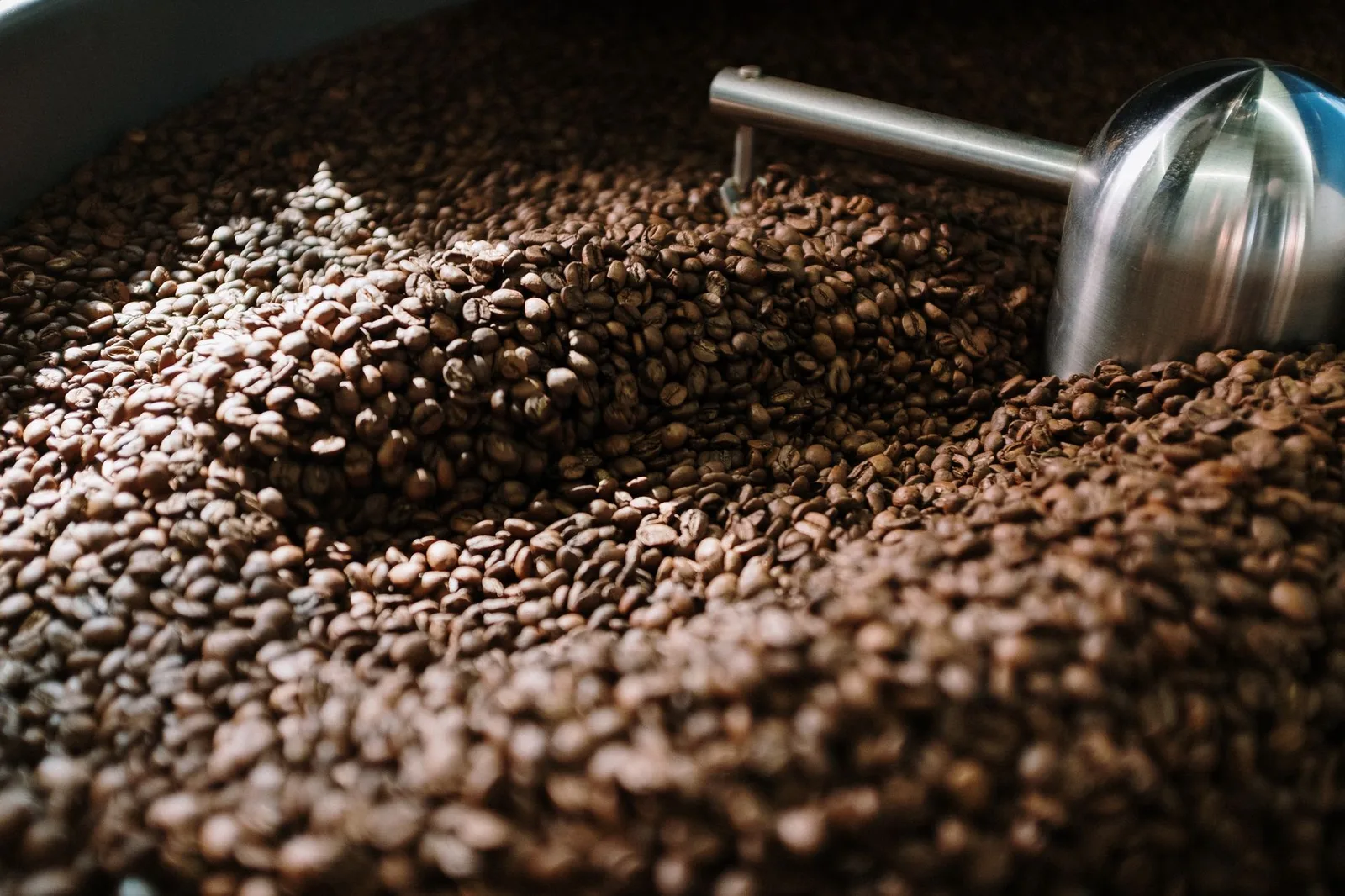
Coffee is typically roasted at 200-240°C. Studies report reductions of 44% to nearly 100% through washing and roasting.
In a lab study on beans from southwestern Ethiopia, researchers deliberately added 12 pesticides, then processed the beans as Ethiopian households do. Washing removed about 15-58%, and roasting up to 99.8%. None of the 12 was detected after brewing. These were spiked beans and a traditional method, not a survey of commercial coffee.
A field trial in Yunnan, China (2015-2016), known here through a literature review, followed one insecticide, dinotefuran. Roasting at 230-240°C for 12-14 minutes cut it by 62.2-100%, and brewing by 92.9-100% in the liquid. It stayed detectable in coffee sludge and wash water, though, 1 to 56 days after treatment.
What can survive the roaster
Heat-sensitive pesticides break down or evaporate. Those with low volatility and high thermal stability can persist, especially when bound to the bean.
In research commissioned by Nestlé and Tchibo, glyphosate reductions ranged from 35% to 90% depending on roasting conditions, and hardly any scenario eliminated it completely. Arabica did better than Robusta, and fast roasting beat slow.
A risk assessment based on that work put five cups a day well below the EU's acceptable daily intake. It looked at glyphosate alone, not mixtures.
Chlorpyrifos and cypermethrin were no longer detected after roasting in the Ethiopian lab study. Yet they rank among the most common residues on roasted beans from the Egyptian market. These studies don't measure the same thing, so the uncertainty is real.
Reassuring tests, with caveats
A major 1993 study found residues in only 7% of 60 green coffee samples. But older methods were less sensitive, and caffeine masks many pesticides during analysis.
A French consumer magazine also tested 51 coffees and found no pesticides in any of them. The test is known here only through a relay published in February 2023. It gives no test date, no method, no list of substances searched and no count of organic coffees.
Is organic cleaner in the cup? The comparison is missing
Organic coffee is grown without synthetic pesticides, herbicides or fertilizers. Yet the research for this article found no study or test comparing residues in organic and conventional coffee as a drink.
The only direct comparison found concerns leaves, and it too comes through a literature review. Among 52 pesticides searched in extracts from 12 conventional and 8 organic trees, none appeared in the organic samples, and thiamethoxam appeared in 6 conventional ones. In the other direction, organic coffees were among the AMPA positives, with no proportion given.
On this evidence, a health risk for drinkers can't be concluded, and neither can a promise of zero.
On the farm, who is most exposed?
The people who spray
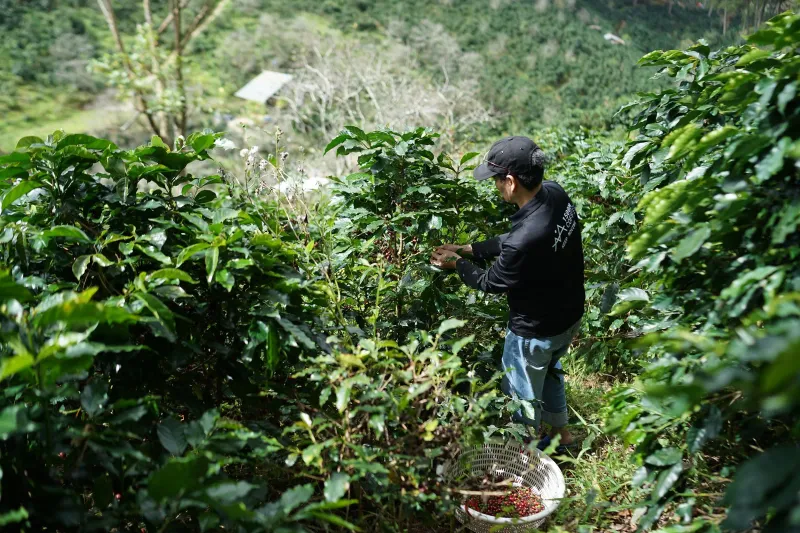
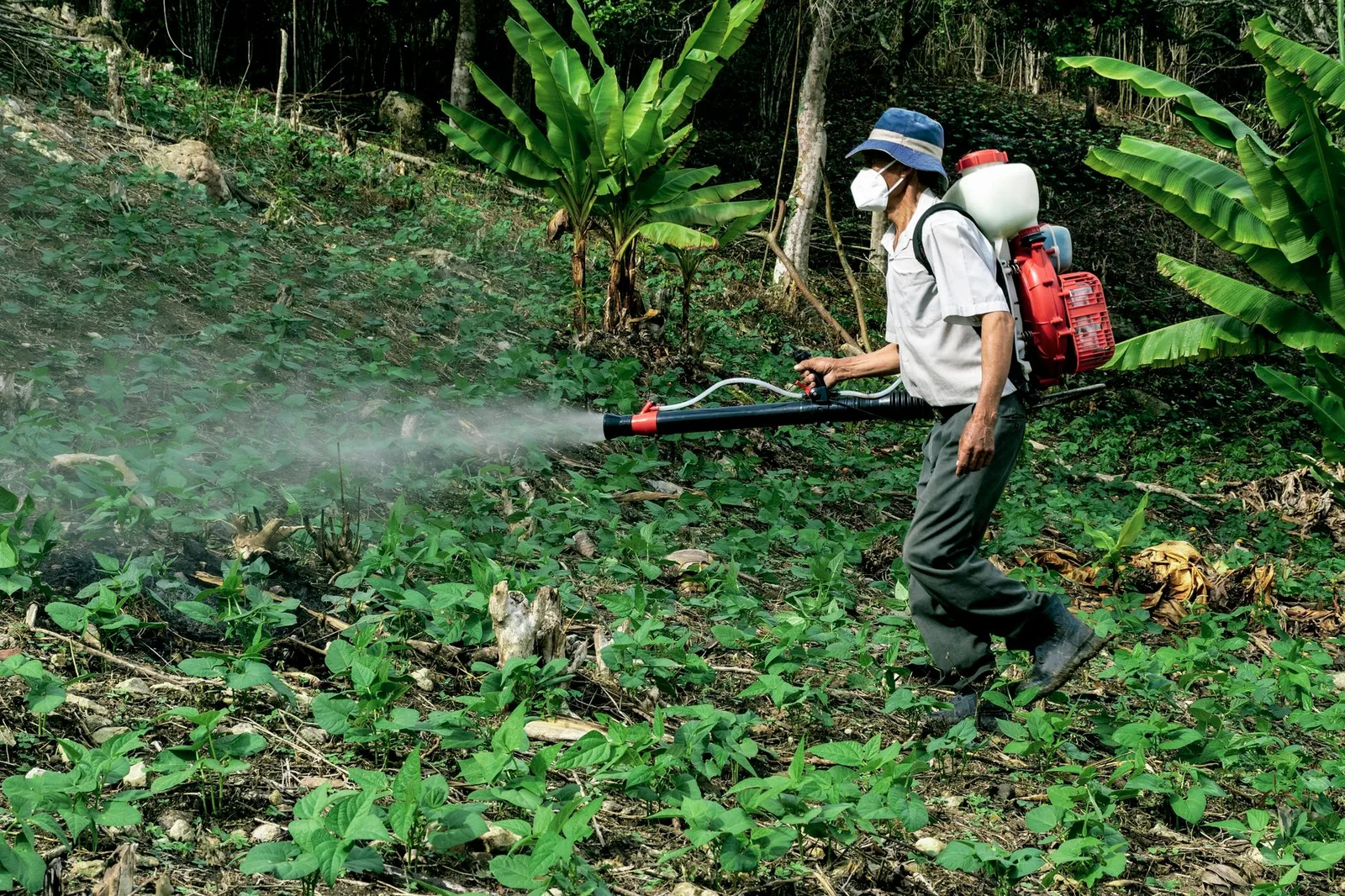
Farmers and farmworkers are exposed through mixing, spraying, returning to treated fields, contaminated water and drift. Their families are exposed through clothing, skin, water and proximity. Symptoms range from dizziness and nausea to convulsions and loss of consciousness.
In 2012, official records in Minas Gerais, which grows roughly half of Brazil's coffee, showed 21 pesticide deaths and 817 agricultural poisonings. In a survey of 412 coffee workers in the same area, 59% reported at least one acute poisoning symptom. Broader estimates suggest up to 88% of farmworker pesticide illnesses go undocumented.
In the Dominican Republic's Jarabacoa region, 87% of coffee farmers reported spraying without masks or gloves. Equipment is often unavailable or unaffordable, and it is impractical in tropical heat. Brazil's law mentions it, but a 2020 assessment found enforcement still seemed far from efficient.
Water, soil and pollinators
Brazil applied 19.8 million litres of pesticides to coffee in 2015. Coffee fields get an average of 10 L/ha, against 7.4 L/ha for maize and 4.8 L/ha for soy. Coffee takes an estimated 27% of Kenya's national pesticide use.
In Colombia, 81.3% of surface water samples from coffee regions contained pesticides, including already prohibited DDT and endosulfan. Among the 159 ingredients, 46 are very toxic to bees, 48 to fish and 11 to earthworms.
Bees matter to the crop, and so do the birds that eat its pests. In one line of research, keeping both away from coffee plants cut yields by an average of 24.7%.
A double standard
Pesticides banned in the EU are still exported to producing countries, and coffee grown with them is legally imported back. Legal limits differ too: for glyphosate, Brazil allows 1.0 mg/kg against 0.1 mg/kg in the EU.
Organic by default: who are the farmers with no label?
Smallholders grow most of the world's coffee: 12.5 million farms, 95% of them under five hectares, for around 80% of production. At least 5.5 million of these farmers live below the international poverty line of $3.20 a day.
What research establishes, and what it doesn't
A 2009 journal study compared a large certified organic scheme in Uganda with farming systems it described as "organic by default". Joining the scheme had positive revenue effects, and applying organic techniques had more modest ones. The abstract gives no figures, and no source says how many farmers are in this situation.
Kenneth Davids, of Coffee Review, wrote in 2011 that entire regions of smallholders are "de facto" organic: "They simply can't afford chemicals for their little plots of coffee trees." A roaster has made a similar point. Neither view is a measurement.
Smallholders are also documented spraying without protective equipment. In Brazil, 90% of family farmers' coffee grows in monoculture, a system that increases chemical dependency. And "organic by default" is not certified organic: no certificate, no inspection, no label.
Why certification can stay out of reach
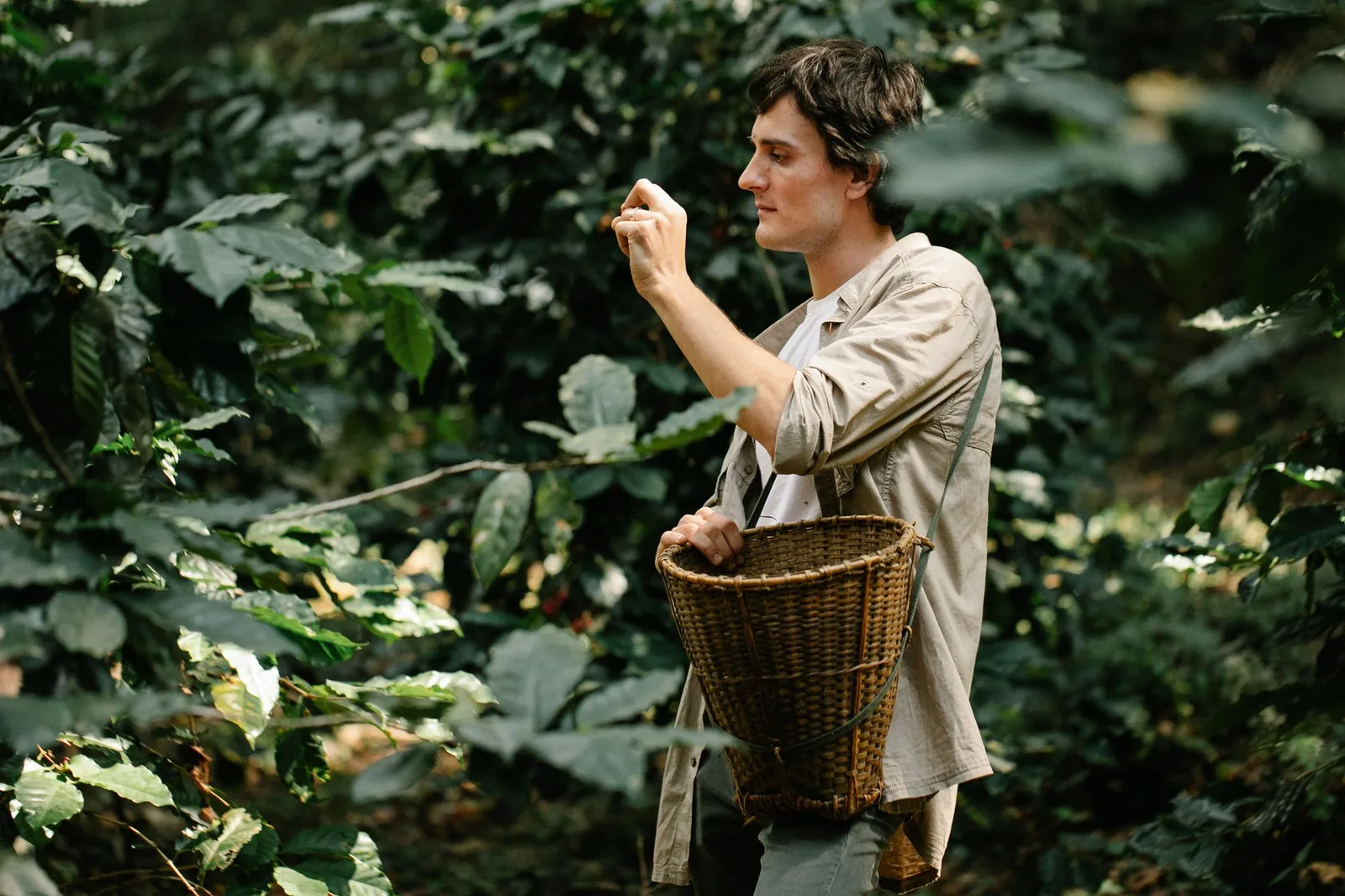
No source puts a figure on the cost of certification. A reference work dated 2004 calls certification a fundamental problem for organic growers, because of its cost and its reliance on external agents. In its Mexican example, foreign inspectors charge fees in line with their home countries, generally very high for local producers.
Local inspection can significantly reduce those costs. The rest remains: laborious bookkeeping and a 2-3 year transition under an approved plan.
Does the label pay once you have it?
Not automatically. Organic prices are normally higher, to offset often lower yields and more labour. A survey of 738 smallholders in Ethiopia, India and Nicaragua matched certified and non-certified households. In Nicaragua, organic cooperatives paid US$1.03 per kg of red cherry, against US$0.82 for non-certified farmers.
Yet in Nicaragua, organic certification lowered yields in two of three statistical comparisons. It brought no positive net revenue effect and no significant effect on household income, though only 38 households were organic-only.
How does the world grow coffee, and what could change?
From shade trees to full sun
The intensive model took shape with the green revolution, which peaked in the 1970s. Farmers were urged to cut shade trees and apply manufactured pesticides and fertilizers, and "technified" or sun-grown coffee followed.
Without shade, potential yields are far higher under favourable conditions. Those yields also need more fertilizer, more pesticide and irrigation. Between 1980 and 2022, the fertilizer price index rose 3.6 times faster than arabica prices and 9.2 times faster than robusta.
Alternatives work, but they are no simple swap
Shade can lower berry temperature by up to 4°C, reducing the rate of increase of coffee berry borer populations by 34%. The borer lives inside the cherry, so insecticides cut infestations by only around 30%, against 80-90% for integrated management, which combines methods such as removing fallen and overripe cherries and setting traps.
Yet in 2017, parts of Brazil, which grows over a third of the world's coffee, saw the worst borer infestation in recent memory. That came four years after the country banned endosulfan, the insecticide that had controlled it. Estimated damage to green coffee reached 5-30% in an area growing about 40% of the crop.
Weather and a large previous harvest played a part. One grower also called the alternatives expensive. Biological control with Beauveria bassiana, a fungus that infects the borer, remains costly and uneven in its results, a real barrier for smallholders.
Organic growing doesn't mean no treatment, either. It relies on prevention, sanitation, resistant varieties and biocontrol, and natural insecticides such as pyrethrins may be allowed for "hot spot" spraying.
Labels and testing: the weak links
The organic coffee area has grown five-fold since 2004. More than 890,000 hectares were grown organically in 2017, the latest figure we found. Half of all coffee is certified, yet campaigning NGOs judge that most schemes do little to curb pesticides.
Most coffee-consuming nations don't systematically test green or roasted coffee for residues, and many jurisdictions have no legal limits for roasted coffee at all.
What your next bag of coffee can and can't change
The most useful step is simple: read an organic label as a choice about the farm, not as a residue guarantee. No comparison we found shows that organic coffee carries less into your cup, and better taste doesn't automatically follow, though fine organic coffees exist. An organic label does mean no synthetic pesticides on that farm, which is where the heaviest exposure lies. It doesn't guarantee the grower a better income.
A label can't show everything, either. A farm without one may avoid chemicals because it can't afford them, or it may spray without protection. Certification costs can also keep a small grower from getting one.
As for your cup, washing, roasting and brewing reduce residues, in the studies available, without any promise of zero. Data on the drink itself remain scarce. Campaigning NGOs are calling for routine testing of all imported coffee, green and roasted, with every detected residue disclosed. Until such data exist, the question stays open.