

Spend an hour on a coffee forum and you will see burrs split into two camps: cones are always more chocolatey, flats are always clearer. It is a neat rule, and an easy one to repeat. There is just one problem: no objective evidence supports such a broad generalization.
Burr shape is not irrelevant, though. Grind consistency, retention and temperature all affect espresso and filter coffee, and all of them depend to some degree on the burrs. So the useful question is not "flat or conical?" but "what actually changes, and how do we know?"
This article sorts the debate into three piles. First comes what can be measured: particle size, fines, retention, heat and grinding speed. Then what you can taste in espresso and in filter, and finally what is marketing. By the end, you will know which questions matter more than burr shape when you choose a grinder.
This article leaves aside blade grinders, the least desirable way to grind coffee. Their blades hack at the beans like a blender, mixing fine dust that over-extracts with large chunks that barely extract. Most run for as long as you hold the button, and even with a timer the grind is hard to repeat from one cup to the next. Any burr grinder, flat or conical, is a massive improvement: the grounds cannot escape until they fit through the gap between the burrs.
How do flat and conical burrs grind coffee?
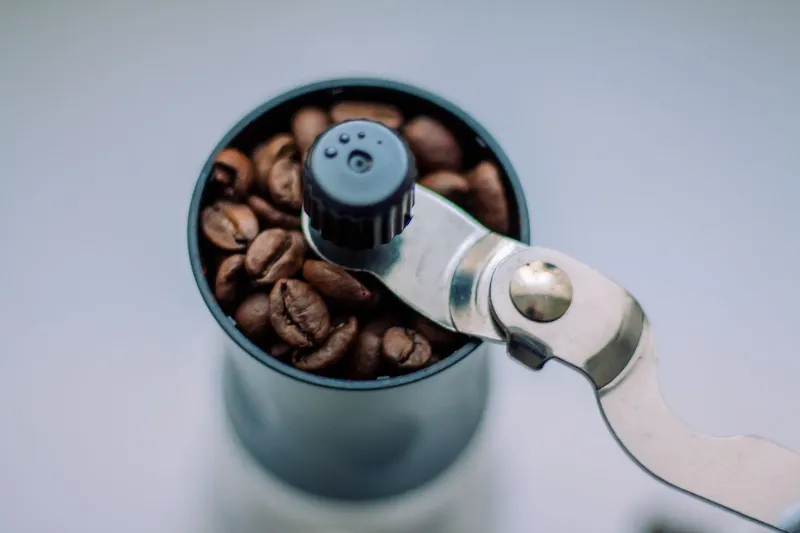
A burr grinder crushes coffee between two surfaces, the burrs.
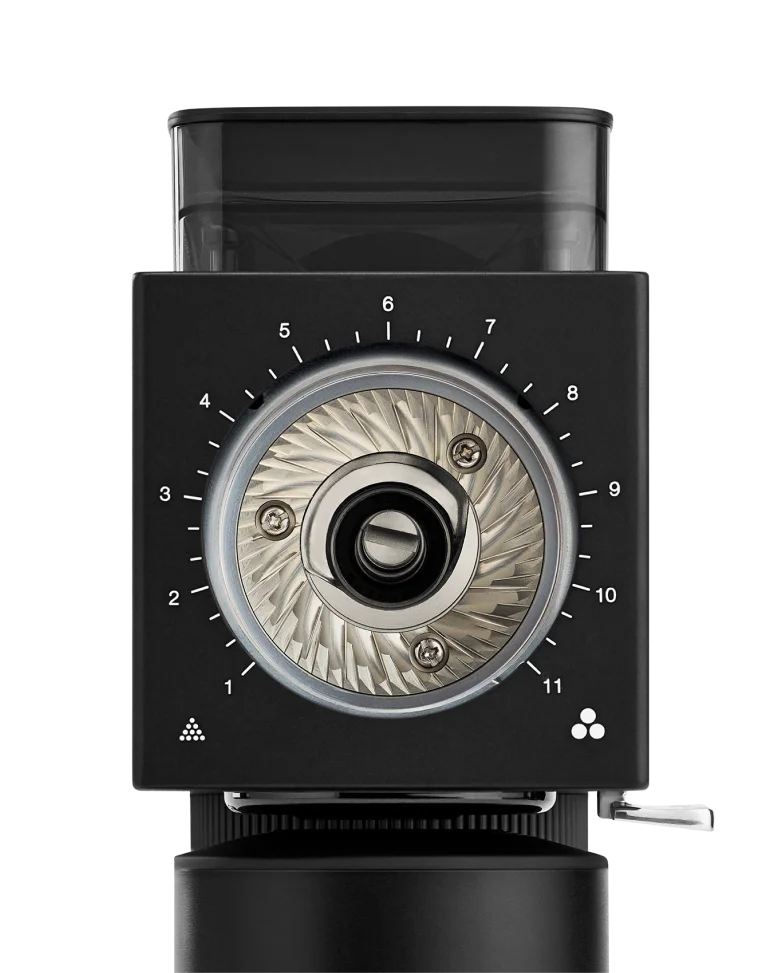
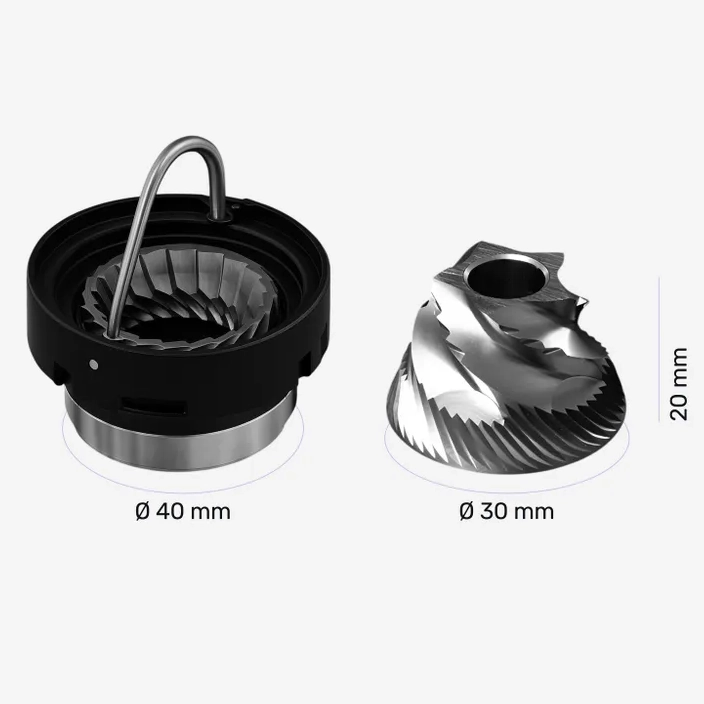
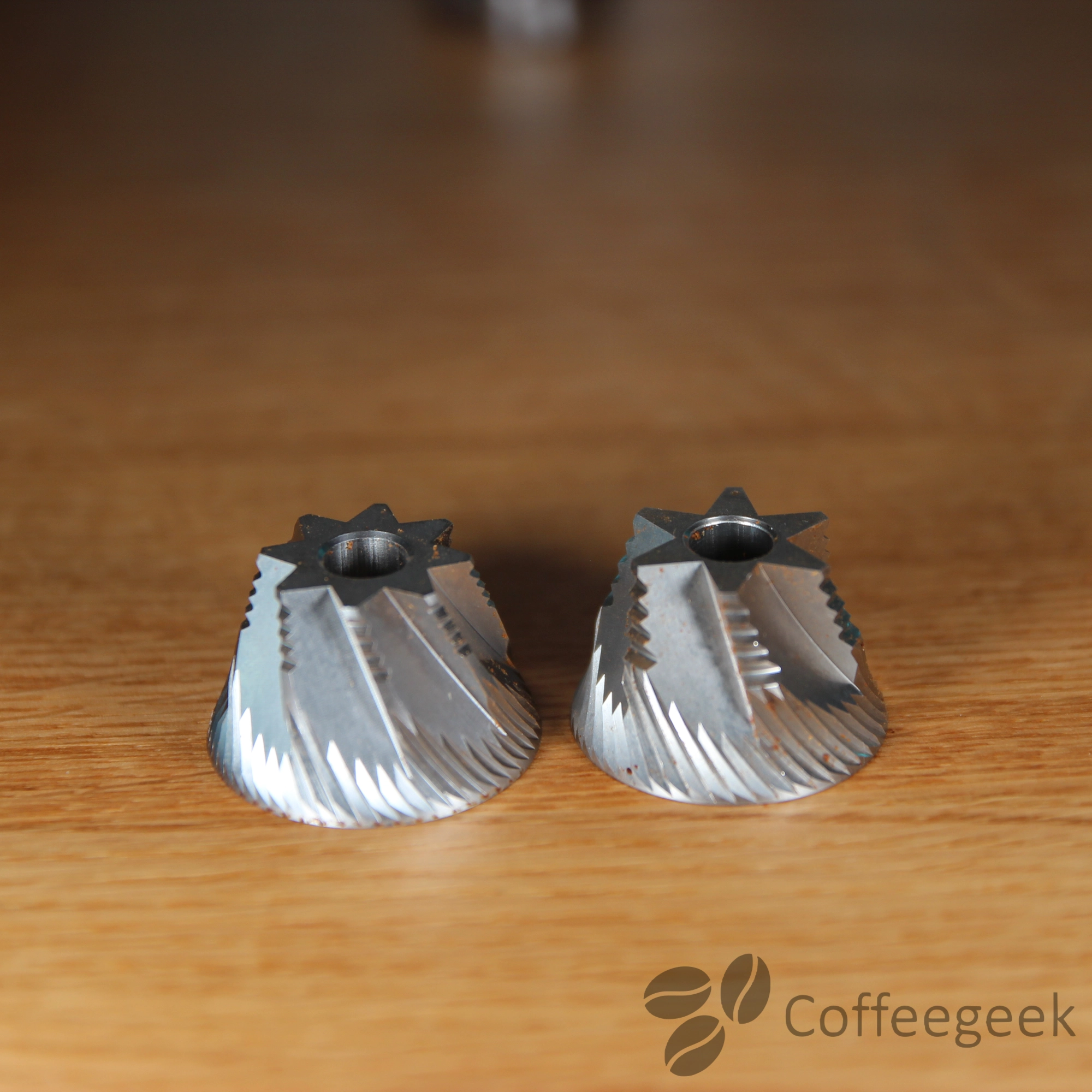
Flat burrs are two rings lying flat on each other, usually horizontal, with angled teeth. The distance between the rings sets the grind size. Conical burrs work vertically: an inner cone with a wide base turns inside a hollow outer ring, also fitted with angled teeth. The electric Timemore Bricks 01S, for example, uses a 40 mm conical set.
Pre-breakers set the pace
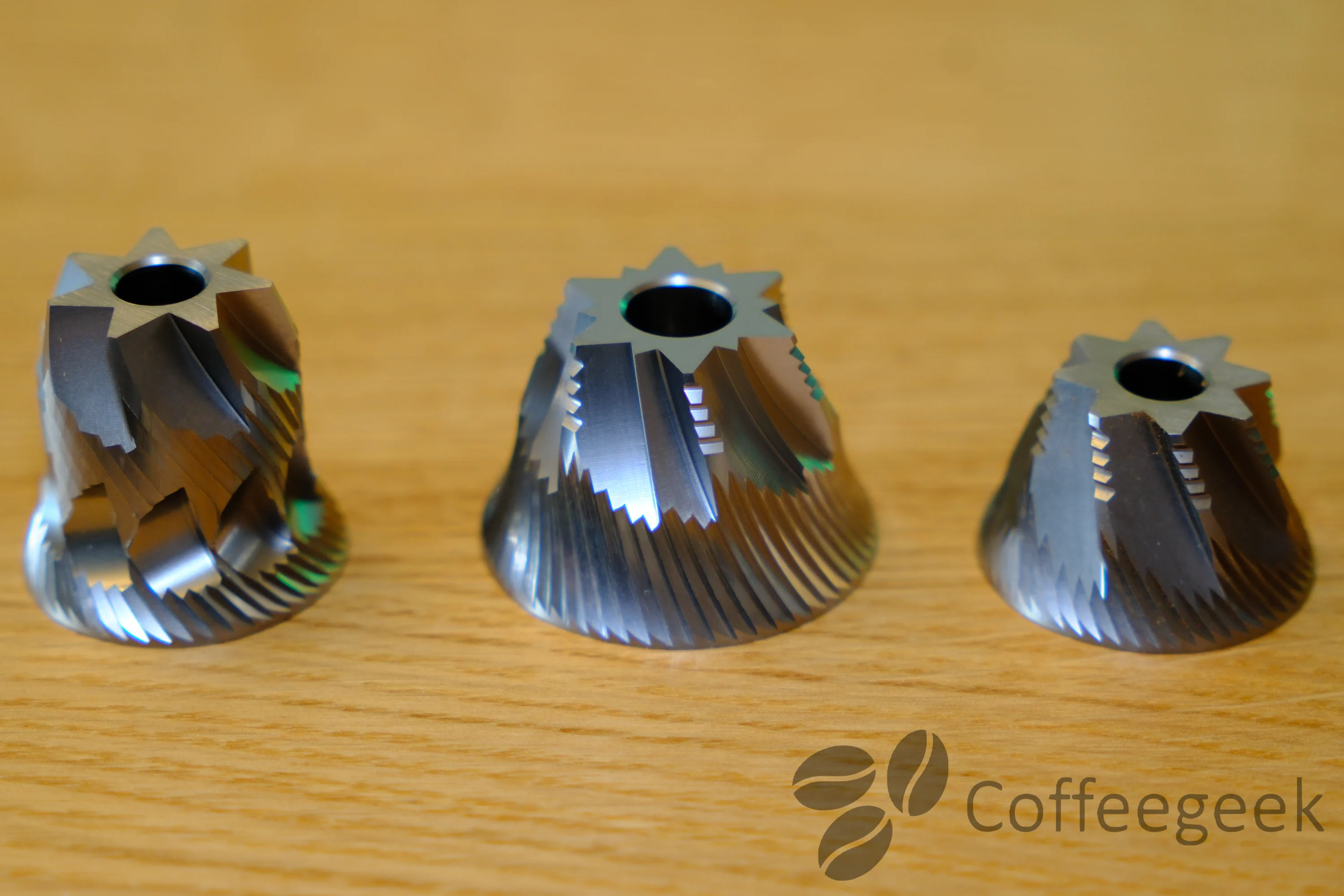
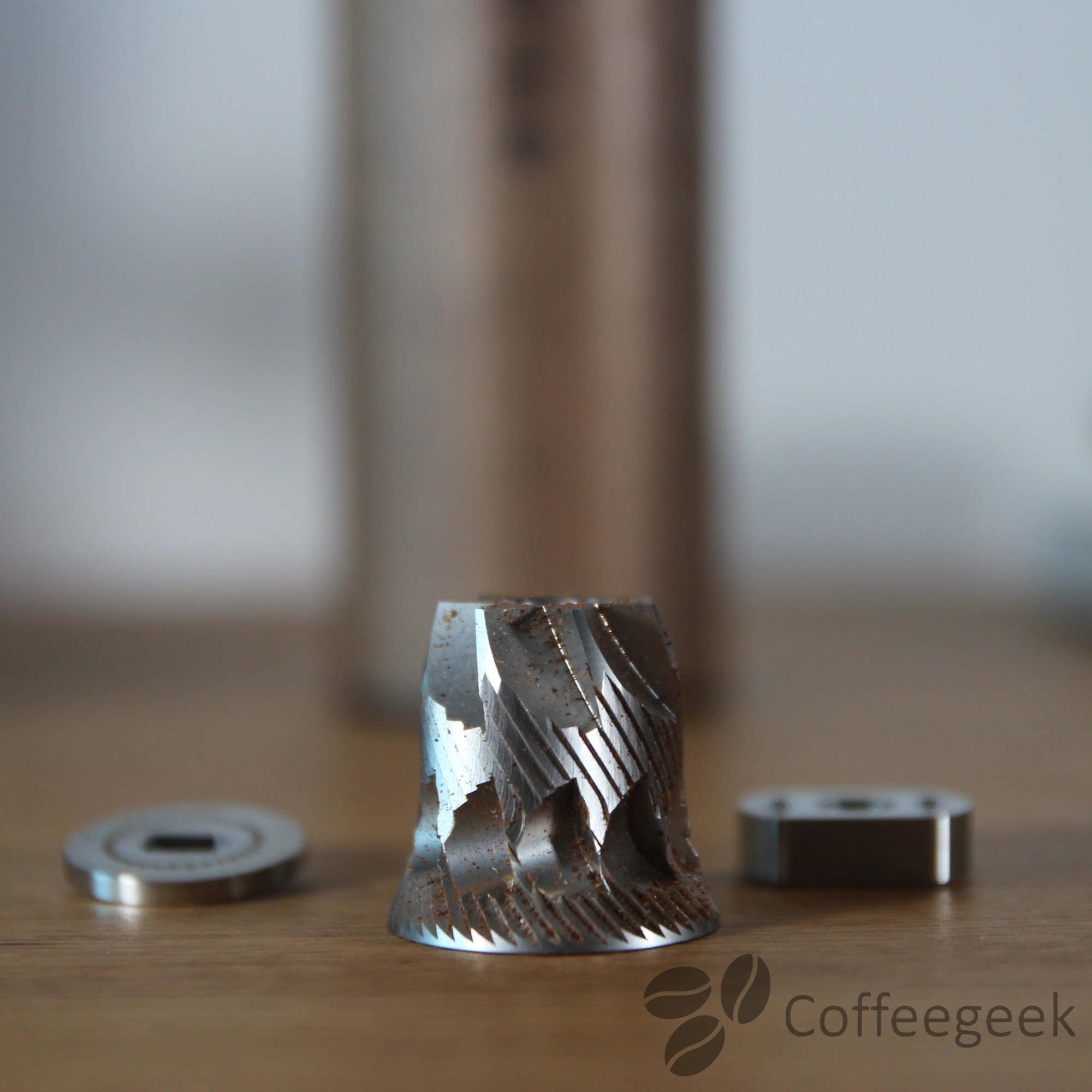
The large grooves on a cone are called pre-breakers. They crack the beans before the finer cutting surfaces and set the feed rate. With fewer spokes, five instead of seven for example, beans feed faster and the motor needs more torque. Cones with more spokes tend to pair with lighter roasts, a pattern seen in use rather than measured.
Crush first, cut last
Most burrs work in stages. The pre-breakers crack the beans, then the finishing teeth cut them and push the coffee out through a small gap. Adjusting the grind moves a burr up or down to change that gap.
Why the shape alone tells you little
Within each family, geometry varies a lot, from the number of pre-breakers to the finishing teeth. The same burr set behaves differently with another drivetrain, motor, alignment or rotation speed. "Flat" or "conical" is only the first word of the description.
Grinder makers steer buyers by burr set rather than by shape. Weber offers CORE burrs from espresso to pour-over and ULTRA burrs for filter only. Option-O offers SSP Red Speed burrs for light and medium roasts, or Standard burrs for traditional espresso.
What can actually be measured: particle size and fines
No grinder breaks coffee up evenly. Every grind is a mix of sizes, and a particle analyzer counts how many pieces of each size are present.
The smallest are called fines, the largest boulders. A fine is a particle smaller than 100 microns, about the thickness of a sheet of paper.
Why fines matter in your cup
Large and small particles in the same brewer extract at different rates. That is why the goal of grinding is uniformity. Fines break off during grinding and almost always dissolve fully, with bitter consequences.
Burr condition counts too. Dull burrs mill the coffee instead of cutting it, and the cup tastes flat and bitter.
What the curves show
The clearest pattern comes from coarse grinds. On hand grinders, the coarser the setting, the more unimodal the distribution became, with one dominant size instead of several. Around 1,000 to 1,200 microns, almost all of them equalled out, with a very small fines population.
One thing is still missing: a flat and a conical grinder measured side by side at the same setting, with a percentage of fines for each.
Does grinding speed change the grind?
A few grinders now let you change the speed, such as the Weber EG-1 and the Victoria Arduino Mythos 2. Their makers say changing the speed optimises the grind for different coffees, without explaining how. The Option-O Lagom P64 and P100 also vary their speed, with no recommended speed per method. Published evidence on speed and particle size is limited, and the effect may differ from one grinder to the next.
At a given setting, a faster speed usually grinds finer, with more fines and a less even spread. On one owner's EG-1, that was all it did: adjusting the burr gap to compensate gave exactly the same extraction and taste.
On conical burrs, going from about 50 to 500 rpm makes a big difference to the curve, while 50 versus 150 rpm on the Weber Key showed little change. The base burrs of the EG-1, a flat design, shifted more between 500 and 1,500 rpm, much like conical burrs.
One espresso test goes further. On a Mythos 2, espresso ground at the higher speed came out finer and slowed the shots. At equal shot time, though, the lower speed consistently gave higher extractions. So speed changed more than fineness on that grinder, for reasons still unknown.
No maker gives an ideal speed for espresso or for filter. Weber suggests starting at 500 to 700 rpm on the EG-1, then tasting other speeds and noting the rpm for each coffee and method. A higher speed is advised mainly to stop the motor stalling with very fine grinds or very light roasts.
Fixed-speed grinders such as the Niche Zero, at 330 rpm, make the choice for you. Several owners of variable-speed grinders also set one speed and change the grind setting instead.
In filter, slow grinding has a reputation for clarity. Users report that the Weber Key, which can drop to 50 rpm, gives more clarity than some would like. The ZP6, a conical hand grinder, owes much of its clarity to its very slow speed and to how its burrs meet the beans.
An owner of several conical grinders, method unstated, finds that between 45 and 120 rpm faster tastes more blended and slower more separated.
Yet another owner reads EG-1 particle data the other way, with more clarity at 1,500 rpm. No one has measured clarity in the cup, and these impressions point in different directions.
The table sums up the speeds that makers recommend and owners use, grinder by grinder: practices, not ideal speeds measured in the cup.
| Grinder | Speed | Use or observation | Who says it |
|---|---|---|---|
| Weber EG-1 (flat) | Variable; start at 500 to 700 rpm | Espresso and filter; go faster if the motor stalls. Stalls at about 700 rpm and below with light roasts | Maker; one owner |
| Lagom P64 (flat, 64 mm) | Variable, 300 to 1,400 rpm | Espresso and filter, no speed given per method | Maker |
| Lagom P100 (flat, 98 mm) | Variable, 200 to 1,700 rpm | Espresso and filter, no speed given per method | Maker |
| Mythos 2 | Variable | Espresso: lower speed, higher extraction at equal shot time | One barista's test |
| Niche Zero (conical, 63 mm) | Fixed, 330 rpm | Espresso | Review |
| Weber Key (conical) | Down to 50 rpm | Filter: slow speed credited with clarity | Users |
| ZP6 (conical, hand) | Very slow | Filter: high clarity | One reviewer |
| Flat burrs, typical | About 1,500 rpm | Can warm the grounds under heavy use | Reference book |
| Conical burrs, typical | About 400 rpm | The slower speed keeps the grounds cooler | Reference book |
Retention, heat and wear: claims versus data
Retention is the ground coffee left inside the grinder. It changes your dose, alters espresso extraction and mixes stale grounds with fresh ones.
One view says flat burrs retain more, because coffee leaves the burr set sideways, which takes more force and a higher speed, while gravity helps a cone empty itself. The opposite view holds that flat burrs leave very little in the chamber, while cones can leave enough to hurt the next dose if the grinder sits idle. Neither view comes with a weight in grams. What does help is the design of the chamber and the outlet, which can reduce retention.
Counts in doses do exist: a stock Mazzer Kony with a doser took about three doses to clear old coffee. The Niche Zero, built around the same Kony burrs, showed very low retention: about 0.5 g left inside when one owner took it apart.
The longer beans and grounds stay in the burrs, the more they get mashed, and the more fines appear. A clogged exit chute makes the grinder re-grind coffee that is already ground. If your grinder suddenly makes a lot of fines, clean the chute before blaming the burrs.
Does a flat burr grinder heat the coffee more?
Flat burr grinders have a reputation for running hotter, because they need more mechanical power. They often spin fast, around 1,500 rpm. Conical burrs often turn around 400 rpm, which keeps the grounds cooler.
Speed and airflow can narrow the gap, say flat burr makers. With good ventilation and a moderate speed, a flat grinder would get very close to conical temperatures. One maker runs its 65 mm burrs at 1,400 rpm to keep the speed at the edge of the burr low.
Speed cuts both ways. A lower speed is usually said to limit friction heat, though most grinders do not get hot enough to risk losing oils and aromas. The opposite view holds that a higher speed may reduce the effect of temperature: the coffee passes through faster, and the motor runs for less time per dose. Neither view comes with a measured temperature.
How long do burrs last?
Conical burrs need replacing after about 750 to 1,000 kg (1,650 to 2,000 lb) of coffee, flat burrs after about 250 to 600 kg (550 to 1,300 lb). A coffee shop might change them once a year, a home user once every twenty years.
Espresso or filter: where can you taste the difference?
The brewing method decides how much burrs show up in the cup. Espresso uses a much finer grind than drip coffee, which sits around 750 to 1,000 microns. At that scale, a few hundredths of a millimetre in grind size make a difference.
Espresso: the most sensitive test
In espresso, flow depends directly on the grind. A typical recipe is 18 g of coffee for about 36 g of espresso in 27 to 29 seconds.
Picture taste on a spectrum: chocolatey, coating body at one end, clarity and florals at the other. In espresso, the Eureka Mignon Silenzio sits firmly at the chocolatey end, with thick, creamy body. The Niche Zero, with its 63 mm cones, is often called chocolatey because of its burrs. Yet many flat burrs, the base burrs of the Weber EG-1 among them, have pulled better cone-style shots.
Blind espresso tests also show a lot of overlap. Five experienced tasters compared a Niche Zero (conical) with an EK43 (flat). With a medium-dark roast, only one paired the shots correctly; with a light roast at about 1:2 (18 g in, about 37 g out), two did. Diluted with hot water as long blacks, four of five paired the cups, but all agreed the gap was small enough to be chance.
The EK43 extracted slightly more, within a margin of error of about ±1% extraction yield. Tasted sighted, all of them thought they could tell the grinders apart easily.
Filter: more overlap than the forums suggest
In filter coffee, SSP brew burrs and SSP's unimodal multi-purpose flat burrs reach the clarity end. Cones cover the chocolatey range, though the ZP6 reaches high clarity. Overall, flats cluster at the clarity end and cones at the chocolatey end, with a lot of overlap.
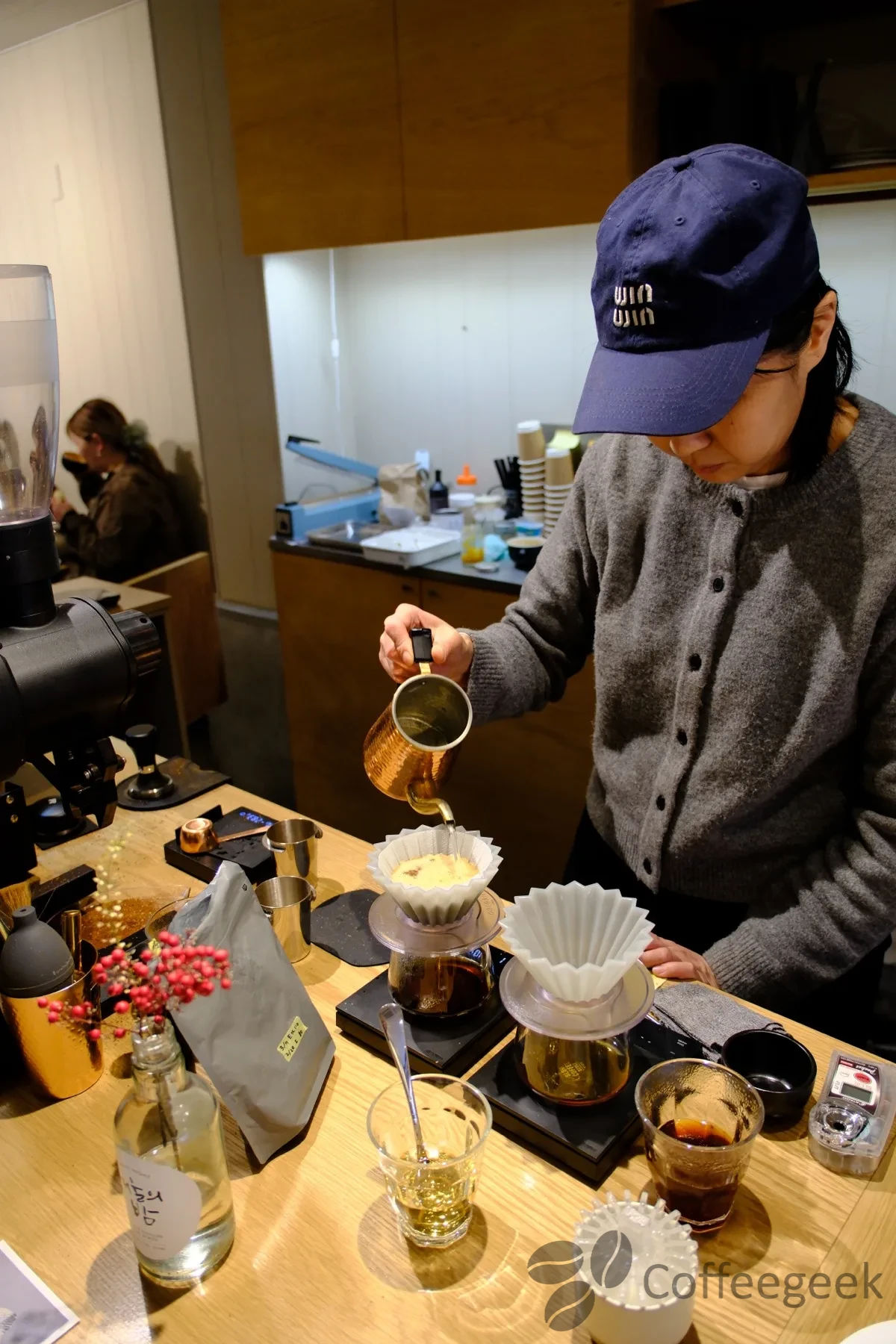
In a blind filter test run by Lance Hedrick, three brews came from a Fellow Ode, a typical flat burr grinder fitted with multi-purpose burrs. Three more came from an Encore ESP, the best-selling grinder ever in the US. The taster identified only two out of three cups in each set.
Tasted blind, flat and conical grinders are hard to tell apart, in espresso as in filter. Dialling in changed the cup far more than switching grinders, and the coarser the grind, the closer flats and cones get.
What is marketing in the flat vs conical debate?
"Cones equal chocolate, flats equal clarity" rests on shared experiences, not data. Flats can taste like cones, and cones like flats, depending on build and geometry. Until more testing is done, links between burr type and taste remain unproven.
Brand content blurs things further. Content sponsored by Dalla Corte, a maker of flat burr grinders, quotes only experts who work for or represent the brand. Its technician says flats will always outperform cones: a cone needs perfect centring as well as parallelism, and the lower cone always sits slightly off-centre.
The same content sums up flats as more consistent and more expensive, cones as quieter, cooler, cheaper and less consistent. No measurement backs these claims, and grinder prices do not follow burr shape so neatly.
Bigger is not automatically better
The same shortcut applies to size. A 98 mm burr is not automatically better than an 80 mm or a 58 mm one. Bigger burrs offer more cutting area and more room for different cuts, but a cheap big-burr grinder can make worse coffee than a well-built smaller one.
Choose a grinder by its build, not its burr shape
Here is the whole debate in one table, before the questions that matter when you buy.
Flat vs conical at a glance
| Flat burrs | Conical burrs | What the evidence says | |
|---|---|---|---|
| Layout | Two rings facing each other, usually horizontal | Inner cone turning inside an outer ring, vertical | Geometry varies a lot within each family |
| Typical speed | Often around 1,500 rpm; variable on some home grinders | Often around 400 rpm; 330 rpm on the Niche Zero | A faster speed usually grinds finer; effects differ by grinder |
| Heat | Reputation for running hotter | Reputation for cooler grounds | No measured grind temperature |
| Retention | Said to retain more, or less, depending on who you ask | Same contradiction | Rarely weighed (about 0.5 g in one Niche Zero); chamber and outlet design matter |
| Burr life | About 250 to 600 kg of coffee | About 750 to 1,000 kg of coffee | About twenty years for a home user |
| Espresso | Many flats pull cone-style shots | Reputation for chocolatey shots | Blind tests: differences small or hard to spot |
| Filter | Cluster at the clarity end | Mostly chocolatey, some very clear (ZP6) | The coarser the grind, the closer they get |
| Marketing claim | More consistent, more expensive | Quieter, cooler, cheaper, less consistent | No measurement backs it |
The cup depends on the whole grinder: burr diameter and design, motor and speed, ventilation and body. Build quality, the drinks you make and after-sales support count as much as the burrs.
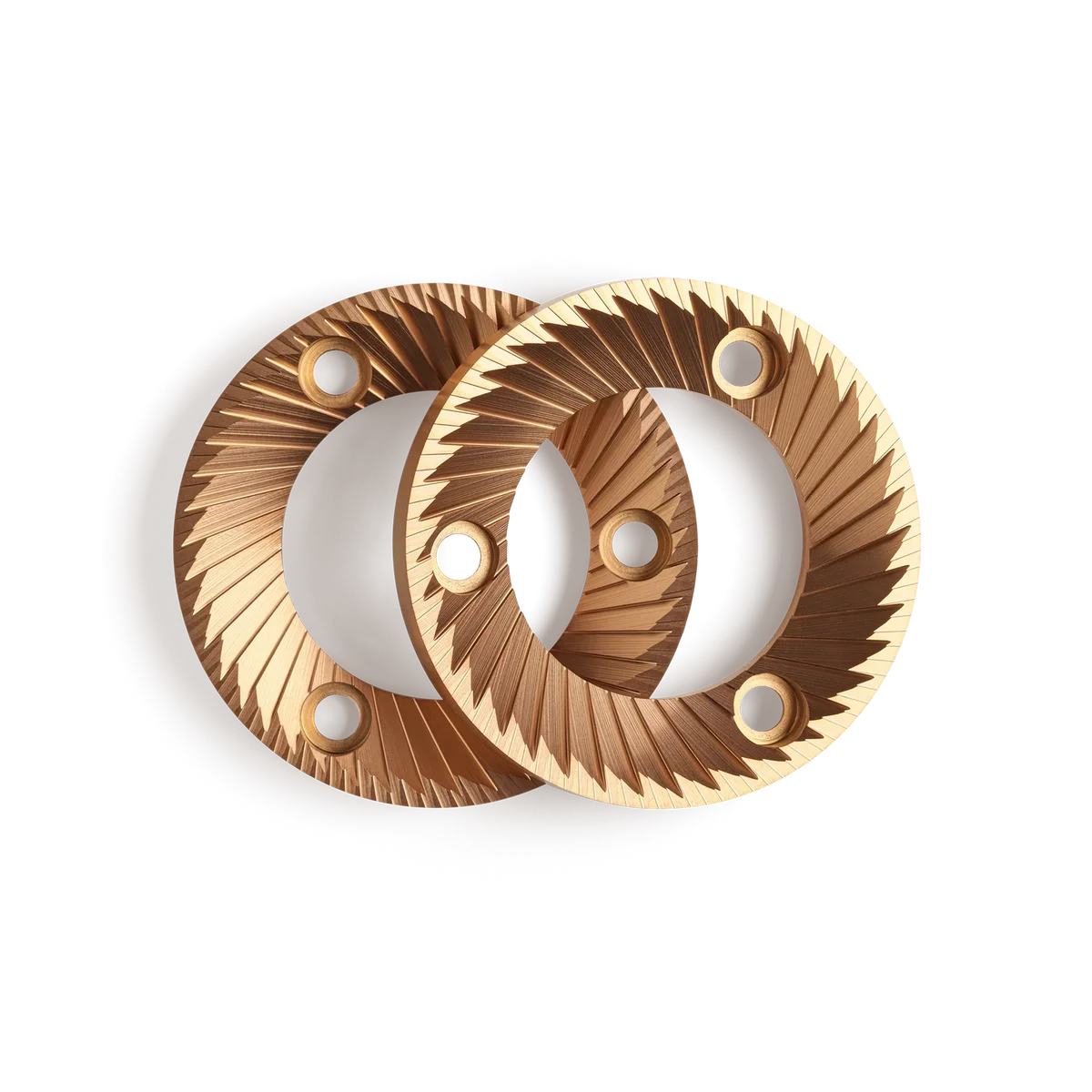
Your brewing method should guide the choice. An espresso grinder needs a good motor that can grind very fine. Most grinders do either filter or espresso well, and some do both. That choice now comes down to the burr set, such as an espresso set or a filter-only set, more than to burr shape.
They say more about your future espresso or pour-over than the word on the box:
- Is the burr set well aligned?
- Does the motor hold its speed when it cuts?
- Does the exit chute stay clear, so coffee is not ground twice?
Variable speed is no guaranteed upgrade. It mostly makes the grind finer or coarser; its effect on extraction rests on a single espresso test so far. Several owners simply pick one speed and adjust the grind instead.
Differences between flat and conical burrs do exist. They only make sense once you name which flat and which cone, in which grinder, at which speed. And what we know about burrs today is a set of working theories, which more data may still overturn.