For some time now, the term F1 hybrid has been coming up regularly in discussions between roasters and specialty coffee producers. Far from being a passing trend, these varieties represent a concrete response to one of the greatest threats facing coffee farming worldwide: coffee leaf rust and the other fungal diseases ravaging plantations. But what exactly does this term mean, and why are these hybrids redefining the balance between yield, resistance, and flavor quality?
What is an F1 hybrid in coffee?
In plant genetics, the first generation resulting from the cross between two distinct parent varieties is called F1 (for "filial 1"). In the case of coffee, these crosses most often involve an Arabica variety renowned for its aromatic quality and a variety carrying resistance genes, sometimes derived from Robusta itself, which is naturally less susceptible to pathogenic fungi. The principle relies on hybrid vigor: the F1 generation statistically combines the best traits of its two parents, with a homogeneity and productivity often superior to traditional open-pollinated varieties.
This approach is not new in itself: cereal farming has been using it for decades. What changes with coffee is the technical difficulty of propagating these plants on a large scale, since reproduction by seed does not faithfully preserve the hybrid's characteristics. Producers must therefore resort to vegetative propagation techniques or somatic embryogenesis to ensure stable offspring, which partly explains the still-high cost of these plants for smallholder farmers.
Catimor, Sarchimor and Hibrido de Timor: the pioneers of resistance
The first major successes of hybridization date back to the discovery of Hibrido de Timor, a natural and fertile cross between Arabica and Robusta that emerged spontaneously in East Timor. Its exceptional resistance to rust made it the reference parent for generating two families that have become essential: Catimor (Caturra x Hibrido de Timor) and Sarchimor (Villa Sarchi x Hibrido de Timor). These varieties were massively deployed in Central America and Asia starting in the 1970s-1980s, literally saving entire industries threatened by epidemics.
The downside, long pointed out by specialty coffee buyers, concerns the aromatic profile: these first generations of Catimor and Sarchimor produced cups judged to be flatter, with less acidic and floral complexity than pure Arabicas like Bourbon or Typica. The challenge for breeders was then clear: preserve resistance without sacrificing finesse in the cup, a balance that long seemed out of reach.
Modern F1 hybrids: combining resistance and cup quality
It is precisely on this ground that the latest generation of F1 hybrids makes the difference. Varieties such as Centroamericano, Marsellesa, and Starmaya were developed by institutes such as CIRAD and World Coffee Research which notably runs the Next Generation F1 Hybrid Varieties program, dedicated to identifying and disseminating these new generations of coffee by crossing Sarchimor with Arabicas renowned for their quality, such as Ethiopian or Sudan Rume varieties. Results obtained in quality competitions show that these new generations now rival traditional, non-resistant varieties, while retaining good disease tolerance and a significantly higher yield.
For producers, the stakes go beyond mere botanical curiosity: faced with climate change, which favors the spread of pathogenic fungi and weakens historic growing regions, these F1 hybrids could well become the norm rather than the exception in the decades to come. For specialty coffee enthusiasts, understanding these varieties also helps to better decipher the technical sheets that accompany bags of roaster coffee, where the mention of an F1 hybrid is no longer a sign of inferior quality, but often a sign of a supply chain committed to more sustainable production.
Steps: how an F1 hybrid is born, from cross to cup
Step 1: Select the two parent varieties
It all starts with the choice of two complementary varieties: on one side an Arabica prized for its aromatic quality, on the other a variety carrying genes resistant to fungal diseases, sometimes derived from Robusta. This choice determines everything that follows, since the F1 hybrid statistically inherits the best traits of each of its parents.
Step 2: Carry out the cross and obtain the F1 generation
The diagram below, published by World Coffee Research in its explainer on F1 hybrids, illustrates this principle of controlled crossing between parent A and parent B to produce the F1 generation:
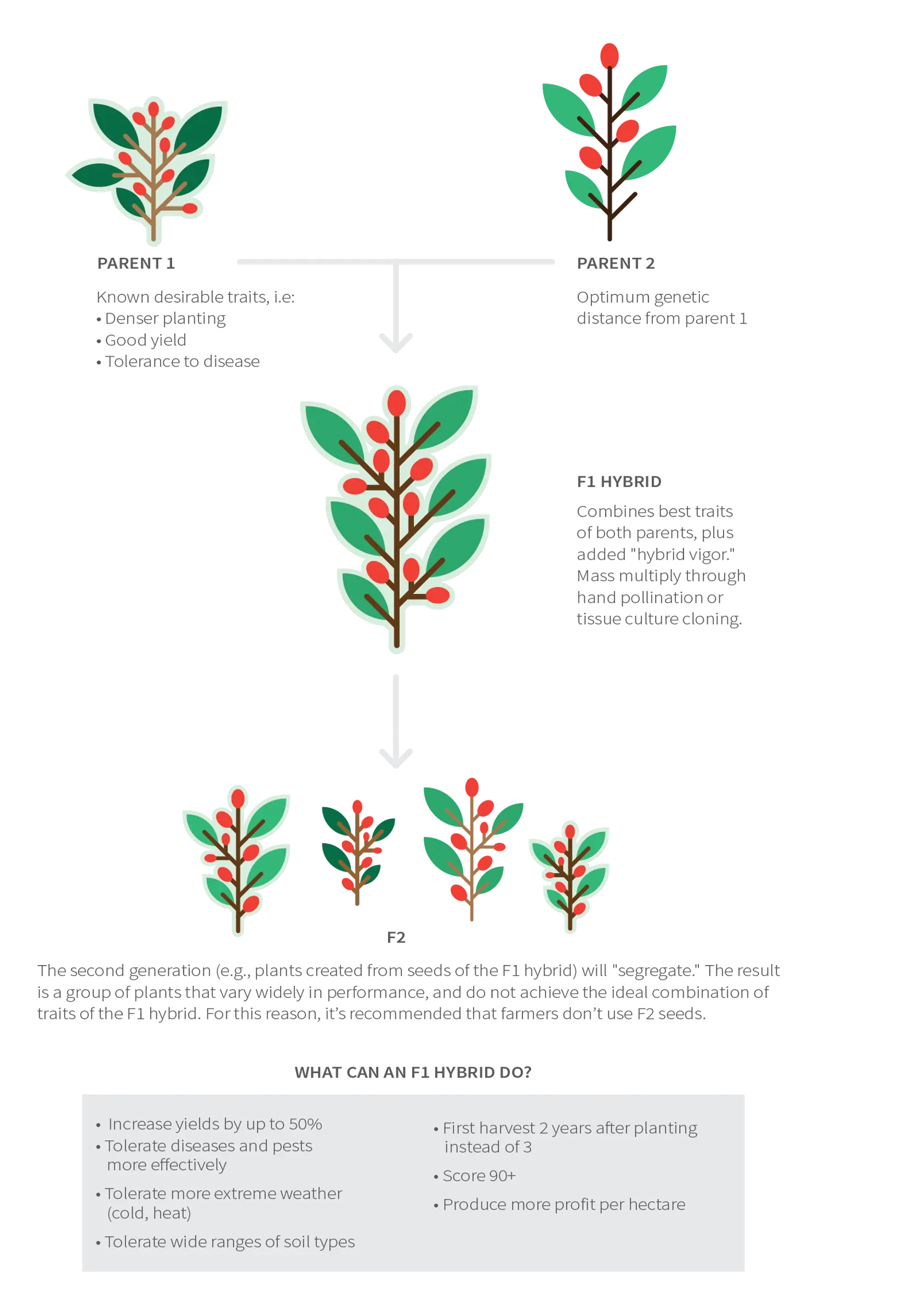
The controlled crossing of the two parents produces the first generation, known as F1. Thanks to the phenomenon of hybrid vigor, these plants generally display greater uniformity and productivity than traditional open-pollinated varieties, while combining resistance and aromatic potential. For a more detailed explanation of this mechanism, the World Coffee Research report on F1 hybrids remains one of the most accessible references on the subject.
Step 3: Stabilize and propagate the offspring
Unlike classic varieties, F1 hybrids do not reproduce true to type from seed. Producers must therefore resort to vegetative propagation or somatic embryogenesis to guarantee plants identical to the original hybrid, a technical step that explains the still-high cost of these plants.
Step 4: Deploy the first resistant generations in the field
This is how Catimor and Sarchimor came about, derived from Hibrido de Timor, deployed massively in Central America and Asia from the 1970s-1980s onward to save supply chains threatened by coffee leaf rust. These first generations prioritized resistance, sometimes at the expense of cup complexity.
Step 5: Refine selection to bring resistance and quality closer together
Breeders then crossed Sarchimor varieties with Arabicas renowned for their finesse, such as Ethiopia or Sudan Rume, giving rise to modern F1s such as Centroamericano, Marsellesa, or Starmaya. These new generations now compete in quality competitions with non-resistant varieties, while retaining higher yield and good disease tolerance.
Conclusion
From the first Catimor and Sarchimor, designed in urgency to save supply chains threatened by coffee leaf rust, to today's Centroamericano and Starmaya, F1 hybrids have come a long way. What was originally only a compromise gaining disease resistance at the cost of finesse in the cup is now becoming a true synthesis between agronomic robustness and aromatic quality.
In the face of intensifying climate change and growing pressure from fungal diseases, these varieties are no longer a marginal option reserved for the most exposed areas: they are shaping part of the future of coffee growing worldwide, for producers and consumers alike. For specialty coffee enthusiasts, seeing an F1 hybrid mentioned on a bag is therefore no longer a warning sign, but often proof of a supply chain that anticipates tomorrow's challenges rather than simply enduring them.
To learn more
Coffee leaf rust: a global threat to your plantations
Coffee leaf rust has been devastating coffee plants for 150 years. Origins, spread, economic losses, and concrete solutions to protect your production.
Read the article →
Roaster Coffee vs Supermarket Coffee: Key Differences
Why buy from a roaster instead of a supermarket? Compare origins, roasting methods, freshness, and aroma quality between artisan and industrial coffee.
Read the article →
Coffee Appellations Guide
Discover how origin, altitude, and preparation techniques directly influence the quality and flavors of your coffee.
Read the article →